The advanced resume strategies included in this article include:
- How to Make Your Resume Reader-Friendly
- How to Ensure Your Resume Stands Out & Grabs Attention
- How to Get More Job Interviews
- How to Boost Your Job-Search Efforts & Success
You Need a Better Way
If you’re not hearing back from employers for those jobs you’re “perfect for,” then there’s likely a lot going wrong with your resume.
The use of “yesterday’s” resume strategies for “today’s” job search isn’t doing professionals (possibly you, too) any favors. Jobseekers can no longer afford to utilize outdated resume techniques to compete for management and executive jobs.
Cookie-cutter intro statements, standard and overused resume layouts and flat content can all be *resume killers*.
A lot has changed over the years within the job-search landscape.
For example, talent management systems that leverage Boolean search strings have been one of the major game-changers.
Also, remember that hiring managers are viewing resumes more as “soft copies” (via computer screen), and you quickly understand that paper choice and size of resume margins, and other minute details, are no longer of concern to you.
Think of the last time you printed your resume.
Bet it’s been a while!
What are considered outdated resume strategies? Below you’ll find a list of “oldies”:
- Strictly sticking with a chronological resume layout
- Mentioning too many soft skills throughout the resume content
- Avoiding the use of relevant key phrases specific to you/your career
- Using a basic resume objective, when a fleshed out summary statement is the better option
- Cutting the content of your resume too short
- Developing a “one-size-fits-all” resume
- Going with a one-page resume — for most, this is a very bad idea!
I won’t mince words — you should use a resume writer to write and improve your resume.
Fail to use a skilled writer, and you could spin your wheels and lose job offers, again and again.
What is your lackluster resume costing you in the long run?
The Best Resume Strategies To Get More Interviews
For those who write their resume on your own, below are 5 of our best resume and submission strategies:
Let’s dive right into the advanced resume strategies to help you transform your resume into something great:
Advanced Resume Strategy #1: Fix The “Front-Facing” Part
Personal branding is hot – very hot!
Once paralleled with top business professionals such as Bill Gates, Donald Trump, and let’s not forget Oprah, personal branding strategies are now applied to job seekers.
Branding is not made up of one thing, but of many.
According to Wikipedia.org, personal branding “is not limited to the body, clothing, appearance, and knowledge contained within, leading to an indelible impression that is uniquely distinguishable.”
A brand put simply is what a person is remembered for most. For example, from a career standpoint, a person could be best known for his approach to problem resolution, corporate restructuring, personal/team achievement, and so on. For clarity, we could call this “Career Brand.”
Can a brand and branding statement be introduced as an advanced resume strategy?
Absolutely.
I once had a client who was known as a “Change Agent” because large companies knew him as someone who entered a failing company and completely changed and improved internal systems, policies, procedures, and staff performance.
That was his career brand – taking companies from the brink of financial ruin and changing them to profitable entities in less than 24 months. He was a top performer, and he was well known corporate-wide for his level of success.
What’s Your Career Brand? How to Identify Your Brand:
To identify your career brand, start by taking your 15-second elevator pitch and reworking the content to include only the key bits about you professionally that are most relevant to mention.
For example:
Are you generally a top 1%-2% sales performer?
Are you award-winning in your industry?
Is there something particularly notable about you that wouldn’t generally be found with someone else at your education or career level?
What’s unique about your skill set that’s also relevant to your job target?
Don’t have an elevator pitch?
In that case, write a short paragraph (4-5 sentences) about your professional career and value.
Boil that paragraph down to a couple of sentences (less if possible). Lastly, fine-tune the paragraph until it contains the exact wording that sells you to the hiring community — generally a tight finished sentence, possibly a few fragments of data (the below examples can help you).
Ideally, your branding statement should contain your top career performance.
Take the following examples for over-achievers:
Supported Award-Winning Campaign While Senior Account Executive … History Growing a Fortune 500 Client Account … Known For Handling Challenging Staff Turnarounds
Top Sales Performer — Generally Grow Sales by More Than 40% and Expand Market Share by 20% to 30%.
Retained Client Accounts During a Major Industry Realignment Maintained Vendor & Client Relationships During a Hostile Takeover & Subsequent Merger & Acquisition
Reduced Staff by 40% for Last 2 Employers — While Increasingly Profitability by 45% and 56% Respectively
Your branding statement might not be as great as one of the above, though that doesn’t mean you can’t find one if you are in a job that doesn’t relish bottom-line achievements.
Using a basic umbrella statement relative to the broadness and depth of you and your career can work too.
The following examples are more basic:
Pharmaceutical Business Developer & Product Marketing Manager — Build New Sales Pipelines by Leveraging Outreach Programs & Aggressively Promoting Pre-Launch/Launch Activities
Senior Financial Analyst — Assess Revenue & Cost Drivers; Support Financial Forecasts (Trends vs. Expectations); Improve Financial Performance
Construction Project Manager – Manage Large-Scale Retail Construction & Facility Management Projects With Budgets of $500,000 up to $1.2M
Wondering where’s the best place to put your new branding statement?
Because a branding statement is typically a one or two-liner and contains all your “sugary career goodness,” position that bugger proudly at the top of your resume — above the summary statement of your resume.
Advanced Resume Strategy #2: Using Taglines — Be Kind to HR Managers
Taglines are terrific, enabling those skimming your resume to immediately see YOUR VALUE from quick glimpses over the text.
Oh sure, talent management systems (TMS) are certainly ruling the roost when it comes to resumes these days, but real people are actually out there reviewing soft and hard copy resumes. Write your resume for those pesky TM systems, sure, but don’t forget about those pesky humans too.
What Exactly are Tag Lines Anyway?
Taking many forms, taglines can be groups of keywords, sentence fragments, and so on. Taglines are nothing more than quick bits of data used to break up content and add more visual interest to your resume.
Taglines in Action
The first tagline example is shown below (Award-Winning Designs – Community Project Lead – Travel Internationally) was perfect for this client. She was targeting a high-end, executive role for a major community development company with project interests on a national and international level.
Certainly, we could have buried this information within the resume summary statement, yet this strategic placement proved the better option by adding visual interest lower in the resume and also introduced a bit more white space to provide a visual break in an attempt to attract readers’ eyes.
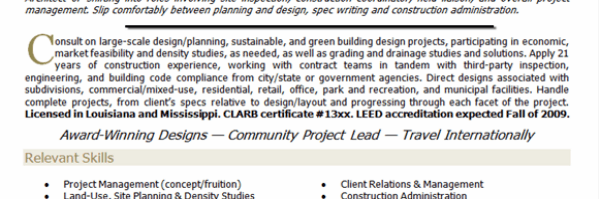
Another example of a tagline is for applying quick “content snapshots” where you would otherwise see nothing.
For example, readers could learn this individual (from the above example) is a turnaround expert by reading the resume; but honestly, who reads resumes these days? By strategically placing this quick tagline in what some might consider an odd location, enables resume readers to see that this person has an impressive track record of performance, without having to dive into the resume body.

Resume taglines will make the skimming (reading) of your resume less laborious for hiring managers and recruiters, no doubt. Taglines are yet another strategic advantage for your use that enables readers to quickly learn more about you and what you have to offer, which in turn puts you one step closer to being called for more interviews.
Advanced Resume Strategy #3: Keywords & Key Phrases — Your Resume’s Secret Code
Once paralleled with top business professionals such as Bill Gates, Donald Trump, Once paralleled with top business professionals such as Bill Gates, Donald Trump, for is likely caused by skills (keyword / key phrases) disconnect.
So, what the heck does that mean exactly?
That means, when hiring managers are searching for ideal candidates in their massive database of resumes, your resume isn’t matching up with the keywords used as part of the searcher’s search string.
The best way to understand this further is by simply thinking about Google.
When you visit Google.com in search of a specific resource, you utilize a certain set of keywords to find what you’re looking for. Another person looking for the same resources might utilize a completely different set of keywords.
Relative to searching through applicant tracking systems (ATS), the concept is very similar. You need to leverage the keyword quality of your resume to make your resume increasingly findable to a multitude of different people potentially using a multitude of different skills/word combinations.
Do you hate what technology has done to the hiring landscape?
Not so fast. >You WANT your resume to be scanned and searched and put in an ATS.
Years ago you relied heavily on a person’s eyes … ones that would stray easily if they hadn’t been given their daily dose of caffeine. In the old days, your resume was sneezed on, drooled on, leaned on, accidentally dropped in the trash — and exposed to a slew of other horrible events.
Technology has in many ways improved your chances of securing a better job — if you take advantage of some of the many great techniques to bend this new technology in your favor.
Take the following potential search string combinations for project management roles:
▪ project manager Cisco partner management
▪ MS project coordinator milestone development vendor management
▪ PMP global engineering process automation project administrator
What keywords should you be looking for?
Keywords are terms specific to a person’s current or target job, such as acronyms, knowledge, skills, and abilities, and/or select buzzwords.
Unlike the last couple of centuries where action verbs (e.g. managed, supervised, oversaw) have been force fed to jobseekers, we’re now in an age where strategically placing nouns within your resume is important.
Still unclear of exactly what keywords and key phrases might look like?
Take the following examples into consideration:
Keywords for Insurance Claims Managers
- Insurance Claims Investigations
- Government Insurance Programs
- Insurance Law Compliance
- Risk Avoidance & Management
- Asset Loss Adjustments
[Related Resource: Cover Letter Sample For an Insurance Claims Rep]
Keywords for Sales Reps & Account Managers
- Divisional/Regional Sales Growth
- Market Share Expansion
- Customer Relationship Management (CRM)
- Sales Team Growth
- New Business Development
Keywords for General Operations Managers
- Business Restructuring & Reengineering
- Team Performance Enhancements
- Multi-Cultural, Cross-Functional Team Management
- Continuous Process Improvements
- Production Planning & Scheduling
Keywords for IT Managers
- Project Lifecycle Management
- New Product Development
- Application Development
- Outsourcing / Contractor Management
- Systems Infrastructure Support
You are probably wondering how the heck you are supposed to know which keywords you should have on your resume.
The answer is you won’t be able to — unless you have psychic powers.
But, there’s still hope.
If you lack those all-seeing powers like the rest of us, you can give your resume that much needed keyword boost by knowing where to look for viable keyword options.
Want to know an insider’s secret to identify ideal keywords and key phrases for your resume?
Sure you do!
You’ll be shocked at how easy this really is:
First, print those job descriptions and get out a highlighter.
Second, highlight job tasks throughout each job description, concentrating on nouns/actions.
Third, cross-reference what you’ve highlighted against the content of your resume.
Now, you really need to be cautious when using this technique because you don’t want to plagiarize the hiring company’s job description.
What you do what to do however is use the job description for inspiration to create your own keyword variations that are similar but not identical.
This way, you add more content variety to the content of your resume as well.
Additional resources to find job/industry-specific keywords include the following:
- Industry publications
- Company websites
- Other people’s resumes
Advanced Resume Strategy #4: Do Yourself a Favor and Use a SAR Writing Style
A SAR writing style in a resume isn’t exactly new — but, it’s certainly a much-overlooked technique, even though we as resume writers have been recommending this technique to professionals for many years.
SAR simply stands for situation/action/result.
There have been many different acronyms and names given to this writing technique, including STAR (situation/task/action/result) or CAR (challenge/action/result).
Regardless of the acronym, the concept is the same: write about the situation you faced and pair it with the results that were generated from your actions. Simple as that.
Using a SAR writing style introduces achievements throughout the content of your resume, adding numbers and percentages that show you as a performer, making this one of the primary reasons for its use.
These visual breaks in content — going from straight text to including numbers/percentages, as I mentioned — helps add “skim factor” to aide with the development of your advanced resume.
With today’s companies, everyone from the secretary to the sales rep and the janitor to the CEO is expected to contribute to the company’s overall financial health.
Secretaries participate in customer service and retention activities.
Sales reps focus on sales growth, sure, but also initiate networking activities and help meet the sales and marketing costs for the sales department. The janitorial staff keeps an eye on utility waste and inventory shrink.
The CEO monitors all the financial cogs throughout the company, ensuring each department meets their designated financial and performance goals.
You can no longer afford to be merely a seat warmer.
Hiring managers and recruiters want to see achievements in your resume because each represents an action and result you have taken to improve the overall “health” of each of your employers.
Fail to take on any active cost-cutting, revenue-producing or retention activities, and you are doing yourself a great disservice.
To make yourself increasingly marketable (another word, WANTED AND NEEDED!), you must focus on becoming someone who benefits each employer’s bottom line, if not already.
How can you introduce achievements in your resume?
You can introduce more achievements into your resume by focusing on your specific job area, department, or the company as a whole.
Think about the situations you faced during your tenure, how you responded, and the results of each action.
What did your job role look like when you started versus when you left?
What had changed?
Improved?
Where did you have some of your biggest impacts?
Did you increase sales?
Save the company money?
Cut dependency on a specific resource?
Is your job not very achievement based?
Well then, maybe you assisted a team with achieving a sales goal or securing a million-dollar client.
Maybe you helped retain a vital client from going to a competitor.
Maybe you identified a major design flaw in a product or identified an issue with a project that would have cost the company a delayed project completion. Maybe you are performing the tasks of another person who was let go.
Maybe you served for a time as an interim executive, board member, etc?
Be sure not to dismiss even the smallest actions on your part, as just a 1% improvement can snow-ball into millions in overall cost savings and/or revenue growth.
Need some help identifying great accomplishments for your resume?
Start by scanning your existing resume to expand on what you already have listed. Look for those areas where you talk about the benefits you generated under each job role. Ask yourself, “I did that. What resulted from my efforts?” If you can answer that question with a quantitative answer, place in your resume.
Take this before and after sentence into consideration as an example of how to introduce additional achievements into your resume:
BEFORE SENTENCE: Introduced continuous improvement activities and improved efficiencies, while reducing operating costs.
AFTER SENTENCE: Introduced a new employee training program that cut billing bottlenecks and improved accounting staff efficiencies. Reduced outstanding receivables by 23.3% as well as shaved an additional 3.8% from overall operating costs.
Note that the before example is very basic, while the after examples provides EXACT details on the improvements and reductions to operating costs.
To rewrite this sentence to show a specific example of the SAR writing style, we could expand the after example a bit further to this:
AFTER EXAMPLE USING THE SAR WRITING STYLE: Responded to a major cash flow problem (situation) by introducing a new employee training program (action) that cut billing bottlenecks and improved accounting staff performance. Reduced outstanding receivables by 23.3% as well as shaved an additional 3.8% from overall operating costs (results).
Advanced Resume Strategy #5: Perform a Thorough Nip/Tuck — You Should Be Mysterious Too!
Generally, hoarding has to do with the massive collection of stuff; i.e. clothes, collectibles, animals, and sadly, trash and food. As we’ve learned, hoarding becomes an issue once the compulsive behavior negatively affects the person doing the hoarding as well as their families, friends, neighbors, and so on.
Well, I’m here to tell you there are resume hoarders too: jobseekers who insist on holding onto less important, irrelevant, and sadly, trash-type jobs without any concern for the negative consequences.
These folks avoid all logic and oftentimes avoid providing solid reasons on why they must keep “this, that, or the other” within their resumes.
The hoarder piles more and more details into their resumes with the hopes that “something” will catch the hiring manager’s eyes, no matter how old or inconsequential. But what resume hoarders refuse to understand is their unwillingness to let go of unnecessary “items” in those resumes are actually hurting their hiring chances.
So, what’s important going forward…
Much like the picture in this article, our biggest “stones” should be at the top. Specifically, the most important details of your career (largest stones) should be front and center in the resume, giving top priority and the best real estate to represent your most important career assets. While the least relevant career details are represented the least (smallest stones) and eventually removed from the resume.
Are you a resume hoarder?
Are you someone who just can’t seem to let go of those old career bits and pieces?
Here’s a typical conversation with someone who hoards certain career details within their resume:
Resume Writer: Those jobs are so old and so irrelevant, Sally. A resume generally covers about a 10-year timeline and tries to remain within a two-page document whenever feasible. By keeping those jobs, your finished resume will likely be three – maybe even four – pages in length.
Jobseeker: I’m okay with that
Resume Writer: Help me understand, Sally, what’s the purpose of keeping jobs in your resume from the 1980s? 1990s?
Jobseeker: They show career progression.
Resume Writer: Yes, I understand that can be important. You’re currently a manager, however. Many of those older jobs are entry-level, support jobs. What value do they add at this stage of your career?
Jobseeker: I know you’re trying to help, but please keep them on my resume anyway.
Resume Writer: You haven’t answered me, Sally. From my perspective, there is no need to keep them in your resume, because they don’t seem to add any additional value to your candidacy nor do they appear to fit with your current job focus. What am I missing?
Jobseeker: For now, let’s leave them in and we’ll revisit the subject once we finalize the resume.
Was the subject adequately revisited once the resume was finalized? Would you be surprised if I said no?
Then, a few weeks later, the conversation goes something like this:
Jobseeker: My resume isn’t getting any attention. Why?
Resume Writer: Sally, we went through this. I urged you to get rid of irrelevancies from your resume, but you ignored my advice. Now, knowing what you know, are you willing to revisit doing the nip/tuck I originally recommended?
Jobseeker: So you’re saying that I shouldn’t show career progression in my resume and that I should simply reflect my management jobs, and avoid showing hiring managers where I came from, how I landed where I am now?
Resume Writer: Well, keeping those very old jobs are helping. When hiring managers review your resume they gain an initial impression of you.
Your resume can’t be a dump.
What you haven’t considered is that keeping those old jobs may send a negative impression, because hiring managers will wonder why you are telling them “all this stuff” when it really doesn’t matter to them. This could make them wonder what kind of employee you’ll be because you’re struggling with focusing on what’s important and excluding what’s no longer important in your resume.
Jobseeker: As someone who hires, I disagree. I like seeing a candidate’s full history.
Resume Writer: Sally, just getting a recruiter or hiring manager to SKIM a two-page resume is a huge challenge these days. Presenting them with a four-page resume like yours can be a setup for failure because you’re working with others’ likes and preferences when it comes to your resume, not your own.
As you can quickly see, jobseekers can sometimes be their main enemy. Resume hoarders purposely, and with some foresight, put up barriers that sabotage their points of entry to interviews.
As a career search strategist, educating a client on the WHYS isn’t always a fruitful venture.
Sometimes we just need to sit back, let the client take the lumps (get a degree from the School of Hard Knocks, if you will) and hope they are more willing to listen and be open to solid resume and career advice should they return for writing help in the future.
Want to avoid being a resume hoarder? Here are 5 ways to rid yourself of excess within your resume:
1. Let those jobs go. What should hit the cutting-room floor? Start by examining and chopping out old, irrelevant, and short-term jobs when feasible. Don’t keep jobs because they are important to you. Keep them because they are important to who will read your resume and consider you for future employment. At this point, it’s probably safe that jobs from the 1970s, 1980s, and yes, the 1990s should be banished from your resume.
2. Don’t “vomit” a summary statement on your resume. Your resume’s intro SHOULD NOT be a compilation of everything you’ve eaten (err, done). Focus only on what’s important to your career move NOW – include no more, no less. Specifically, don’t include software and soft skills. If you’re a manager, don’t include support-level responsibilities – or when absolutely necessary, broad-stroke (minimalize) those support job responsibilities.
3. Recognize that you have transitioned from having a job to having a career – and rewrite your resume accordingly. Jobseekers should write about their best works; their best assets; their best skill sets; their best results. The resume should be the best representation of your career, so stop thinking of your resume as a chronological list of your job roles.
4. Do you remember that? Training that you attended years and years ago are equivalent to wearing an old brown suit to an interview. Big, big turn-off! There comes a time when you must acquire fresh training to avoid your skills from becoming outdated — you won’t be able to compete! Get rid of old training in your resume and be sure to replace with fresh ones.
5. Inactive memberships, lapsed executive board participation, and love of dogs. “Well, the hiring manager may call me for an interview because she’s a dog lover too?” But couldn’t that “bite” you too? Maybe the hiring manager was once bitten by a dog? Maybe she’s a cat-loving hiring manager? Don’t presume that because you were once a member of XYZ industry organization or served as a board member of the local Humane Society that you’re going to get any preferential treatment.
So, here’s one last nugget of advice:
Critique every millimeter of your resume – strategically map every word, every fragment, and every sentence. Talk their language by showing the hiring company how they will get their return-on-investment (ROI) out of you.
Successful Professionals Invest in Themselves
Jobseekers can no longer afford to utilize mediocre resume-writing techniques to compete for top jobs — or any job for that matter. Cookie-cutter intro statements, standard and overused resume layouts and flat content can all be *resume killers*.
So, how do jobseekers gain a much-needed advantage?
Pairing up with the right writer is certainly a great start.
But, why specifically should a jobseeker use the services of a professional writer?
The answer is simple.
Top resume writers know what makes a great resume; i.e. the use of a branding statement, a tagline or two, relevant keywords/key phrases, and a situation/action/results writing style.
Why Does a Professionally Written Resume Cost So Much?
There’s a story that Picasso was sitting in a bar in Paris and a woman approached him and asked if he could do a quick sketch for her on a napkin. He drew her portrait and handed her the drawing — and a request for a considerable amount of money. She was outraged. “But it only took you five minutes!” she protested. “No, madam, it took me all my life,” replied Picasso.
When you have your resume created by a professional writer, the time invested in crafting a custom document is not limited to the effort required to gather information about your job target, previous experience and accomplishments, education, and value to your next employer — although this is significant. It’s not limited to the several hours of time (and gallons of blood, sweat, and tears!) it takes your writer to carefully choose each word and phrase for maximum impact.
While there is significant time spent gathering and synthesizing the details of your career and designing a wholly unique and customized resume, the value of your professionally written resume originates in the skill of the writer — talent developed through the study of effective resumes, training in modern communication techniques, and thousands of hours of writing experience.
You are also benefiting from what Picasso recognized as his biggest asset — a lifetime of knowledge and experience.
Your professional writer knows how to paint a custom word portrait for you that is a snapshot of your career progression and ambition, designed to attract job interviews.
More than a few jobseekers have turned a single sheet of paper — their professionally written resume — into the job of their dreams.
Will you be next?
Why Your Resume is So Critical — All The Places It Helps You
The most obvious reason why you might need a resume is when you’re looking for a job. But there are many other reasons why you might want to put together a resume now, even if you’re not actively seeking new employment.
Your employment situation can change in a heartbeat — the company may be acquired, or sold, or go out of business. A great boss may leave for a new job — and maybe he wants you to come with him. Or maybe his replacement wants to bring in his own people.
Even if you don’t need a resume to apply for a job online, it is useful to have a well-organized, neatly formatted document to hand to the hiring manager at the beginning of an interview. The resume can also serve as “talking points” to guide the content of an interview. The time invested in compiling information on your credentials, skills, and accomplishments can also help prepare you for the job interview itself.
Your current employer may even request a resume from you — for example, to include in a proposal the company is preparing for a new contract. It’s not uncommon for key personnel bios to be included in a response to a Request for Proposal (RFP) or applications for grants.
If you want to apply for an internal promotion or transfer, you may not think a resume would be required, but often, it is. An internal recruiter or a hiring manager in a different part of a big company isn’t going to be familiar with all the aspects of what you do — and even if they have access to the job description for your job, that won’t tell them about the specific contributions that you’ve made in your current role. It’s your job to quantify and document your achievements — and a resume is a good way to do that, even for an internal job.
A good time to create — or update — your resume is when you are preparing for an annual performance review. Documenting your accomplishments can help you prepare to show your manager how you’ve added value to your job — and department — since your last review.
The resume development process is also a good time for self-assessment. A well-written resume tells the “story” of your career — demonstrating consistent themes and supporting information that highlights your qualifications for the job target you’re seeking while omitting irrelevant information and jobs.
Outside of an employment context, you may also be asked for a resume if you’re going to be a speaker for an organization or an event, so they can use the resume to create your bio and speaker’s introduction.
Individuals being considered for a political appointment — for example, a state government committee or board — will likely be asked for their resume. The same is true for individuals being considered for key volunteer roles — for example, if you are asked to be on a nonprofit’s board of directors.
You may also be asked for a resume if you are being considered for an award — or being given an award in recognition of your work or volunteer efforts.
Resumes are also a tool for networking. Someone you just met who is interested in learning more about you may ask for your resume. This contact may help lead you to unadvertised job openings.
In the same way, getting your resume in the hands of someone who knows you well can also lead to new opportunities.
They can use the resume to pass along to other people who might be in a job to hire you, or to use as a “door opener” to introduce you to other people who might be useful in your job search.
The resume can also be used as a tool to market you. If you work in a service-oriented job, your skills, education, and expertise are a critical part of what makes you credible to potential clients.
Having a resume — or a bio-based on your resume — that communicates why you are a good choice to provide the service can help fill your appointment book, especially for therapists, clinicians, coaches, and teachers.
A document that showcases your credentials can be an important part of your company or practice’s marketing materials.
Resumes are important at any age.
A resume can be a good resource for high school students applying for scholarships and submitting college applications. It can be updated throughout the college years and be used to apply for internships and part-time jobs.
And, of course, once you graduate from college, you’ll likely need a resume to apply for your first job.
It’s also important to note that a LinkedIn profile is not a substitute for a resume.
Because a LinkedIn profile is public (even if you have your privacy settings locked down on LinkedIn, someone can still take a screenshot of your profile or create a PDF of it), there may be information that you do not want to include in your LinkedIn profile that can help demonstrate your accomplishments to a prospective employer.
In addition, a resume can be customized to target a specific job, while you can only have one LinkedIn profile.
Furthermore, a well-written resume can actually help you populate your LinkedIn profile, making it easy to complete the “Work Experience” and “Education” sections.