 For many job hunters, it’s not writing and sending the resume that’s the hardest part of the job-search process.
It’s the job interview.
Whether from lack of preparation, inexperience, or just plain fear of speaking in public, too many people fail to get the job they want – and are qualified for – because they don’t properly prepare to ace the interview.
If you’re one of these people, here’s your chance to stop worrying and start succeeding.
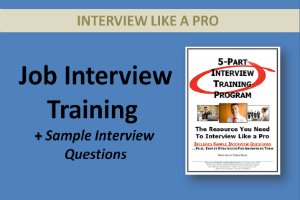
In this 5-Part Interview Training Program, I will outline key topics for interviewing success, in an easy-to-read, easy-to-practice fashion that will have you interviewing confidently and more prepared than you ever imagined you could be.
“Think of interviewing as a game. Every game has rules, players, and strategies for winning.”
A simple statement, but what my strategies will do is break down a seemingly laborious and complex interview process and provide you with straightforward and advanced bits of advice.
In this 5-Part Interview Training Program, you will learn:
- Techniques for getting past the pre-screening stage and getting the actual interview.
- How to identify and communicate your strengths, using the keywords interviewers want to hear.
- The rules to effectively interviewing – no matter the job title.
- How to answer difficult questions, such as ‘What are your weak points?”
- Tips to help you manage more than one interviewer (group or panel interviews).
- Ways to handle situational questions, HRs new weapon for identifying ideal candidates.
- How to prepare yourself for ‘trick’ questions that might not seem geared towards your job.
In addition, I will provide you with sample interview questions, tips for creating your own questions so you can prepare for interviews, and handy tactics for staying organized so that you are prepared when companies call in response to your application. You will also learn how to evaluate yourself and your skill sets so that you can negotiate salaries and benefits effectively.
The author of 4 books and countless articles on resumes, cover letters, job search strategies, and interviewing techniques, I provide you with a strong set of tools designed to help you get beyond the obstacle of interview preparation and improve your chances of obtaining your dream job.
Intro to The 5-Part Interviewing Program
 Each section of this 5-part interview training program covers those interview topics you should be obsessing about in order to “pass” the gauntlet of interviews you’ll go through over the coming weeks and months.
This program is divided into sections to help you understand and apply each section before progressing to the next portion of the program.
A slow and steady approach to interviewing will prepare you more effectively for what lies ahead.
For every interview you participate in that doesn’t go well, you’re losing time and money.
Oh, sure. Even bad interviews could be chocked up to practice.
But, who wants to job search longer than necessary?
It’s torturous.
You, as the jobseeker, want (and likely badly need) the job.
The company needs someone with your skill set, so what’s the problem?
Think of interviewing as a game. Every game has rules, players, and strategies for winning.
The players … what can I say about the players? Well, you’ll interview with people who don’t have a clue what they’re doing, while on the other end of the spectrum, you’ll interview with hiring personnel who leave no question unasked. You’ll feel like a mental midget before they’re finished with you … not because of your words, or a potential gap in your education, but because they’ll exhaust you and tilt you off your game.
Interviewing is a game learned. Of course, you could sit down and win with little prep work and practice. After all, inexperienced players continuously make final tables with those seasoned professionals during Texas Hold ‘Em tournaments. Poker, just like interviewing, is a game that even unpolished players (or interviewees) can win — or minimally, do well at.
The rules … well, there aren’t any per se. Unless you count showing up on time, saying all the right things, and exuding nothing but professionalism and confidence as rules, well, then I guess those are rules. Actually, let’s just call them guidelines because companies hire people who lack professional attributes and/or the right qualifications all the time. The interviewing game is the most unfair process out there. Positions you’re perfect for may not yield an interview; and with others that do, you may not reach beyond the first interview.
Let’s face it. You’re also dealing with a hiring person who brings their own set of variables to the table.
First, knowledge of the position itself. For example, those who hire for technical positions might find themselves clueless about the exact wants and needs of their own internal department. Company reps who lack knowledge surrounding your skill set can definitely generate a major disconnect right from the onset.
Second, the person sitting across the desk or speaking on the other side of the phone has his own set of preferences. Maybe he doesn’t like the sound of your voice. Maybe you answered a question incorrectly and left a less-than-favorable impression.
See what I mean?
Some variables you just won’t be able to control.
The biggest lesson to learn: the right person doesn’t always get the job.
Too true, too often … right?
Starting now, right this minute, you’re going to this take this lesson and learn from it. Changing your entire mindset about how the game is played will certainly affect your impact during interviews. After all, if the process is a game in play, it can be manipulated.
Can’t it? Let’s give it a shot.
Take each section, weighing your options and adjusting your strategies accordingly.
Part One — Getting Past the 1st Stage so You Can Participate in the Game
If interviewing is the game, prescreening is the initiation process. It’s the stage where you need to “dance” the most in order to be invited to an in-person meeting or a second-stage phone interview.
A primary purpose of a pre-screening call is to ask a standard set of questions, scoring and further analyzing the person based on those answers. Receive a passing score, and you move onto a more official interview. Fail and you’re out of the running. Just like that.
Preparing for the initial interview phase is much like planning for a head-to-head challenge you know is coming, but not exactly sure of the day or time of its arrival.
So, there’s no time to waste.
Prepping yourself will have a huge effect on the overall process, starting with the effectiveness and quality of your answers to the confidence which you exude. It’s time well spent to ensure everything runs smoothly, starting with the initial phone call.
… ring, ring …
You: “Hello”
The Caller: “Good morning, is this Mr. … ”
You: “Yes, this is him.”
The Caller: “Hi, this is Melissa from Arc Enterprises here in San Francisco. We received your resume and cover letter in response to a position we currently have open. Do you have some time to talk?”
At this stage, your heart hits your throat. You’ve been waiting for this moment for weeks.
After all, this position is perfect. It’s been posted a couple of times, yet the company has experienced trouble filling it. Almost destiny that the company can’t find that perfect person, you’re still on the hunt, and now, the company has finally honed in your resume and cover letter.
Now what? You know Melissa has questions for you about your resume, and maybe, specifics about how your skill set *exactly* matches the requirements of this company. Are you prepared?
The Caller: “Mr. …, I noticed you have a fair amount of project management experience. Can you tell me what knowledge you have working on project quality control?”
The caller’s only purpose is to wean people out, so knowing what to say versus what to avoid at this stage is important. Now, I’m not implying you should lie or fail to disclose certain information from the onset. What I am saying, however, is to not show your less-than-perfect hand before the caller has the chance to see your full strengths.
Your sole goal at this point is to get by level one of the game. Going beyond the pre-screening phase will take some prep on your part.
By your home phone, or on your person at any given time, you should possess a cheat sheet that contains key points of detail during any hiring conversation. Your sheet can be as detailed as you wish it to be, combining a variety of strengths, achievements, personal attributes, and other notables important to the person on the other end of that line.
The below sample list assumes you’re targeting similar types of positions. Should you focus on distinctive roles, however, consider having 2 or 3 cheat sheets each focused towards its intended audience.
Sample Cheat Sheet
List your 5 strength points
Your strength points are your kingpin skills and abilities that should roll off the tip of your tongue during most, if not all, conversations with hiring personnel. Tasks outlined within those job descriptions that matched your background, to the letter, are those to list below. List your top strengths relative to these positions:
________________________________________________________________________________________________________
________________________________________________________________________________________________________
________________________________________________________________________________________________________
________________________________________________________________________________________________________
________________________________________________________________________________________________________
Keywords
Keywords are important not only within the resume and cover letter, but also throughout your dialogue. Culminate a list of 10-20 keywords or key phrases that capsulate skills, acronyms, or other key points you wish to mention while answering the interviewer’s questions. Pluck key points from your resume, as well as, from the various job descriptions you’ve continuously reviewed over the last days or weeks.
Example of keywords for sales professional: market expansion, new client development, customer-centric account management, global sales, Fortune 500 account maintenance, up-selling/cross-selling
___________________ ___________________ ___________________ ___________________
___________________ ___________________ ___________________ ___________________
___________________ ___________________ ___________________ ___________________
___________________ ___________________ ___________________ ___________________
What’s important to this company?
The most successful salespeople in the world will tell you they don’t sell for a living. They simply focus on fulfilling the customer’s needs and desires and making a sale is only a byproduct. Products and services are offered to save the customer time, money, and resources, they’ll tell you. It’s all about the customer. The same is true for hiring companies. Provide answers applicable to the hiring company. It’s all about them.
________________________________________________________________________________________________________
________________________________________________________________________________________________________
________________________________________________________________________________________________________
________________________________________________________________________________________________________
________________________________________________________________________________________________________
Keywords
List your 5 top achievements
Again, it’s about what’s important to the company. For management positions, you know efficiency, quality, personnel harmony, and a whole slew of additional issues are likely a concern. For sales positions, market growth while keeping existing clients happy is what keeps the executives up at night. Think about the notable achievements that generate the most value and interest to the caller. To add a fresher perspective to those listed within your current resume, think about different angles.
________________________________________________________________________________________________________
________________________________________________________________________________________________________
________________________________________________________________________________________________________
________________________________________________________________________________________________________
________________________________________________________________________________________________________
List your 5 weak points
Weak points are those from the job descriptions you can’t completely fulfill. For example, the company asked for a bachelor’s degree and you possess only an associate’s. Or, 10 years of experience was required, yet you hold only seven. List your top weak points relative to this position:
________________________________________________________________________________________________________
________________________________________________________________________________________________________
________________________________________________________________________________________________________
________________________________________________________________________________________________________
________________________________________________________________________________________________________
Note: Upon completion, never discuss those listed unless you’re forced to. There’s no good reason for placing a beacon on your shortcomings.
Questions to Ask The Interviewer
During the initial interview phase, questions will arise. Jot them down, so you don’t forget.
Want a sample list of questions to consider before wrapping up? Some to consider …
When a second interview isn’t proposed or expected:
- When can I expect a follow-up phone call?
- Are there any concerns about me fulfilling this position?
After scheduling a second interview:
- Who will I be meeting with during this interview?
- Are there specific concerns about this position, or within the department?
 In Part #1, I outlined the importance of the first stage of interview prep. Creating yourself a cheat sheet, a guided list to reference while speaking, will enhance the value of the information you provide to callers. Although I provided a list of core categories to focus upon, feel free to expand further. Integrate additional key points you feel are important; i.e. foreign language skills, participation with a particular board/committee, or some other niche skill, for example.
Another critical component to have on hand during a phone call is a copy of your resume.
Referring to it will also help you answer those tough questions while enabling you to hone in any specific areas the caller points to for clarification.
A bit basic, but also consider keeping cough drops or tic-tacs nearby.
Phone interviews can be lengthy at times, and having something small to slip into your mouth can help should you become dry or begin a slight cough from the continuous talking.
Continuous talking … this brings me to my next point. Studies have shown that we talk uncontrollably when nervous.
I know I do!
A great technique used by sales professionals is to first analyze the demeanor and speaking patterns of the person on the other end of the line and adjust accordingly. For example, if the caller is calm, as well as, a light speaker, adjust your speaking patterns to meet theirs.
If your caller is completely on the other end of the spectrum, maybe loud or fast speaking, don’t necessarily mirror them. It would be odd to have two people speaking loudly to each other. But, adjust your voice accordingly to somewhat meet theirs.
Just a thought here; but a loud, fast-talking person might indicate their nervousness. J
Part Two — Landing the In-Person Interview
If you felt the pre-screening process was grueling, you’re in for a real treat with the in-person interview. It’s a moment to strut, showing the interviewer what you’re made of beyond flat pieces of paper (resume and cover letter).
Face-to-face interviews oftentimes vary from company to company. For example, you may meet with a human resources person or an administrative support person. Or, you may meet with a department head or a Vice President. Across the table, you may face one person or several.
It’s likely you’re part of the new advanced breed of jobseeker, armed with knowledge learned from the Internet, so I won’t bore you with standard logistics relative to the types of interviews.
What I will do, however, is cover a bit of stock detail just to cover my bases.
Panel interviews, also referred to as group interviews, are oftentimes headed by two or more interviewers. Those present might represent different departments or several tiers of management; i.e. team lead, shift supervisor, and department manager.
Someone from the HR department may also be in attendance. Group interviews are increasingly the preferred format as work schedules become increasingly full. It’s sometimes easier to get all hiring parties in attendance for a 30- to 60-minute interview, versus scheduling the interviewee for interview sessions over several hours or days.
A panel interview should be your interview of choice, and let me tell you why.
Meeting within groups means the company is dedicated to hiring the right person, quickly and effectively. No playing around with this company.
Not only a time saver for the company but a great learning environment for you as well. Examine the camaraderie.
How are they talking to each other?
Do you sense animosity?
When dealing with one interviewer, you’re left to chance.
Does this person have authority to hire or is there simply as another obstacle, serving as another pre-screener?
One-on-one interviews can be frustrating for this purpose alone. You leave the interview with the promise of a follow-up phone call after the interviewer speaks to another hiring authority. Jobseekers have often found this to be code for brush-off.
After all, why bring you in to meet with one person, when in actuality, it’s another who wields the hiring wand. What’s the purpose?
At the end of Part #1, you were guided to two important questions when scheduling the second interview:
- Who will I be meeting with during this interview?
- Are there specific concerns about this position, or within the department?
Let’s focus on utilizing this “intelligence” to enhance the in-person interview. Remember, it’s about exploiting this information to your benefit, molding your answers exclusively to the company’s hiring wants and desires.
Below, I’ll cover the questions along with deciphering the answers, and subsequently, how to use it all to make you a kingpin for the company opening.
Who will I be meeting with during this interview?
Those present in the room are your “target demographic,” and with that said, alter your answers to cater to those present. For non-technical hiring reps, as an example, scale back your answers to be less technical. Convert your answers to layman’s terms. For executive personnel, focus on bottom-line results. Emphasize your skills that are soft spots for the company. Is the company attempting to penetrate a certain market, and you headed a successful market penetration plan with a former employer.
Right now, this company has a problem.
They’re losing money, whether through sales, customer value, or overall efficiency. It’s a problem that needs remedying … and fast!
A position unfilled, or possibly, occupied with someone with less than favorable enthusiasm, is costing big. Who’s suffering? Managers, support personnel, customers … that’s who. Work needs to be done.
When an employee is mentally or physically absent, it’s up to support or management personnel to pick up the slack.
Think of it as business infrastructure cancer. Big words for what otherwise might not be viewed as a big deal.
Cancer, however, will erode employee relations while increasing stress levels of those involved. You could even say it creates a trickle effect of pushing those toying with the idea of seeking alternate employment to go from contemplating to pursuing.
So, what does this have to do with you?
It’s critical for you to understand that with the shiny faces you’re seeing across the table, there’s an under-belly of pain — present with those in the room, or those back at their desks. Those on the other side of the table want you to be the answer to their hiring needs.
Much like you don’t want to interview more than necessary, well guess what, companies with openings don’t want to spend valuable time interviewing either.
Alter your answers to not only focus on what you can do but also focus on what you have done. This is where your list of top achievements within Part #1 will come in handy. Of course, customize your list based on the position, the company, and those sitting across the table.
Are there specific concerns about this position, or within the department?
Remember, I mentioned in Part #1 about how sales professionals focus exclusively on the customer’s needs and the sales order is thought of as a byproduct?
Well, here’s a fine example of how this methodology also applies to a hiring company. Think of the hiring company as your customer. You’re the problem solver. The quintessential problem solver, actually.
Now, let’s say you didn’t heed my advice, or you failed to ask these questions. Don’t worry. It’s not the end of the world. But, definitely, ensure you ask those two little questions the next time.
Situational Interview Questions
Companies have shifted to new interview strategies, including the application of situational interview questions. Typically not presented within the pre-screening phase, it’s definitely worth mentioning here to ensure all ground is covered. Much as technology is evolving, hiring companies continuously seek out and utilize alternative interview strategies and questions to add value to the process.
Situational interviews are hardly technology driven, but if traditional interview questions would represent Interviewing 1.0, well, situational interviewing would be Interviewing 2.0. The objective is to learn more about candidates, which also saves the company money down the road by avoiding bad hires. Hands down, companies are spending big bucks to hire — which is why they don’t mind spending five- and six-figure finder fees to quality recruiters. Hiring the right person is critical. A task to be handled once, not again and again.
Situational interview questions are just as they sound. Situations are presented to you, and you’re questioned how you would handle them. Some will be easy, while others will leave you scratching your head, struggling to determine a proper response. I’ve found some interviewers like having fun with these questions, maybe even making it a game to slip you up.
Lessons Learned by Miss Vitto in My Cousin Vinny
Do you remember this infamous scene from the movie, My Cousin Vinny (1992)?
Marisa Tomei’s character, Miss Vitto, is on the stand … unwillingly I might add. By the Prosecutor, she is asked to provide the correct ignition timing for a specific year of Bel-Air Chevrolet.
The question was a set-up. Pure trickery. But, Miss Vitto knew the answer.
And, Marisa Tomei went on to win an award for her performance.
Interviewers, if feeling a bit devious, and with motive, may try to derail you with a trick question as well. You’ll find this scenario more prevalent with those in technical fields. Know your stuff, and maybe you’ll be awarded a new job.
In these cases, don’t be afraid to ask a question before answering.
Doing this does two things.
First, it provides you added information so you can formulate an answer.
Second, allowing the interviewer to provide added details also gives you a few more seconds to contemplate the question, so you can think the question through more effectively. Also, don’t be afraid to take a few additional seconds before opening your mouth.
Silence is fine.
Embrace it, don’t run from it.
Oftentimes, situational questions evolve around employee relations, project management, financial administration, and overall operational functions.
Sample questions will likely encompass a mix of the following:
- How would you handle this situation?
- What would your action be?
- Forecasted results from the action?
- Provide an example of when your situation, action, result (SAR) application was applied?
What would you do? Hmmm … really, what would you do?
Situational questions typically revolve around conflict and resolution topics, including:
- Project Deadlines
- Client Management
- Employee Relations
- Project/Program Logistics
- Public Relations
- Work Delegation
- Internal Conflict
- Creativity
- Cash Flow/Expenditures
Reviewing the conflict topics and examining the list of sample questions, make a list of potential questions relevant to you, and your career field.
Sample Question #1
________________________________________________________________________________________________________
________________________________________________________________________________________________________
Keywords
Sample Question #2
________________________________________________________________________________________________________
________________________________________________________________________________________________________
Sample Question #3
________________________________________________________________________________________________________
________________________________________________________________________________________________________
Using the sample questions, create potential answers:
You’ll notice two sections below for each question. Utilize the first answer category to jot down your instinctual answer, while using the second category to fine-tune it. Keep your answer tight, yet thorough. To help with the process, follow the SAR (situation, action, result) formula.
Question #1 Answer
________________________________________________________________________________________________________
________________________________________________________________________________________________________
________________________________________________________________________________________________________
________________________________________________________________________________________________________
________________________________________________________________________________________________________
Question #1 Answer – Fine-tuned
________________________________________________________________________________________________________
________________________________________________________________________________________________________
________________________________________________________________________________________________________
________________________________________________________________________________________________________
________________________________________________________________________________________________________
Question #2 Answer
________________________________________________________________________________________________________
________________________________________________________________________________________________________
________________________________________________________________________________________________________
________________________________________________________________________________________________________
________________________________________________________________________________________________________
Question #2 Answer – Fine-tuned
________________________________________________________________________________________________________
________________________________________________________________________________________________________
________________________________________________________________________________________________________
________________________________________________________________________________________________________
________________________________________________________________________________________________________
Question #3 Answer
________________________________________________________________________________________________________
________________________________________________________________________________________________________
________________________________________________________________________________________________________
________________________________________________________________________________________________________
________________________________________________________________________________________________________
Question #3 Answer – Fine-tuned
________________________________________________________________________________________________________
________________________________________________________________________________________________________
________________________________________________________________________________________________________
________________________________________________________________________________________________________
________________________________________________________________________________________________________
Recap
In Part #2, you were introduced to in-person, group interviews, focusing on the purpose and structure of such formats. Group interviews are your friend since they allow you to meet the company’s team of representatives to further educate you on whether this is the company for you.
You also learned how to utilize information received from your initial pre-screening conversation to your advantage. Who will I be meeting with during this interview? Are there specific concerns about this position, or within the department?
If you didn’t ask these questions after the phone interview, as I’ve already indicated, don’t worry. Ensure to ask them the next time. In the meantime, you may be able to answer the second question all on your own. Companies oftentimes have the same pains; less-than-favorable production, out of control overhead costs, customer issues, out-of-date systems/technologies, and so on. Sometimes you only need to stretch your imagination to come up with potential issues the company is currently trying to resolve.
Also within Part #2, I covered situational interview questions. Situational questions can be the most challenging, in my opinion— because even though you might forecast potential questions, you never know what situation the interviewer is going to focus upon. So, if you want to cover your bridges, practice answers to different variations of situational questions. Remember to follow the Situation/Action/Result (SAR) formula whenever possible.
 Part Three — All About the Questions
Now that you know about in-person, group interviews, now it’s time to cover the more important facet of interviewing: question prep. Today is all about the questions. Unlike those asked during the initial phone screening, you’re embarking on the in-depth phase of interviewing.
At this moment it’s about increasing your interviewing IQ by viewing your background from the eyes of hirers.
The resume and cover letter were your marketing pieces, and now the interview is your chance to represent your stated applications. How you apply and carry yourself is what hiring managers want to know now. The resume now serves as only one facet of you that may receive some additional attention, but overall, it’s about the one-on-one interaction between you and “them.”
Interview questions focus on demonstrated and potential actions, such as …
- How you analyze
- How you interpret
- How you problem solve
- How you’ve achieved
- How you’ve managed
- How you’ve overcome
Jobseekers tend to get nervous during interviews. They’re uncertain of the questions that lie ahead.
Below you’ll find various questions separated by position. Reviewing the list, you’ll notice that not much has changed over the years — although you’ll find I don’t cover those stock questions that everyone dreads, such as what are your weakness, strengths, and why should I hire you?
The core theme of the questions remains, while I have taken a slightly different approach. If you’d still like to prepare for those outdated questions, below you’ll find a sample for your consideration:
- What are your strengths?
- What are your weaknesses?
- Why should I hire you?
- Why do you want to work for us?
- Where do you see your career in five years?
- Tell me about yourself.
What are inappropriate questions? Notice I said inappropriate, not illegal. Illegal is not an accurate term since “illegal” questions don’t mean that someone goes to jail. It might mean civil action, however, but no handcuffs or jail time. J
Recognize those inappropriate questions by listening to those asked that have nothing to do with the job. For example, questions about marital status or family … no-no questions. Other questions to avoid answering include those about political affiliation, race, and religion.
Should you be faced with an inappropriate question simply decline to answer. Sometimes, asking about family, for example, is a simple misstep. It’s just human nature for conversations to stray to family, so don’t fly off the handle should an interviewer ask about such things.
I would be exceptionally concerned if the interviewer honed in on religion or race. Should the questioning become uncomfortable, don’t hesitate to bring the interview to a halt. It’s your right should the conversation go in the wrong direction, making you feel uneasy — not only about the interview but about the company too.
Beyond the above stock list, below you’ll find more detailed questions for your attention. Although not a complete list, I strongly encourage you to use and/or customize the below to specifically match your career field.
You can never prepare too much, only too little.
Receptionist/Secretary/Administrative Support
- Describe your temperament? Are you a patient person? Give me an example of when your patients were tested, and how you handled the situation.
- Are you an introvert, someone who prefers to work alone, for example, or an extrovert, a person who strives within a team, working collaboratively?
- How would you describe your personality? What would you change if you could?
- What has been your involvement with international clients, management teams, or operations? What are your foreign language skills?
- Are you able to handle concurrent projects? Provide examples of projects you’ve handled.
- What software and network skills do you possess? Any experience with Intranets?
- I noticed you’re not currently attending college, is that right? Tell me about your professional development plan. Do you read books, attend seminars, or keep current on affairs using Internet resources?
- How are you with handling various dialects and accents from overseas callers?
- Do you perform better within a support role, or within a lead one? Are you ideally shooting for a position that requires additional responsibilities, or is remaining within a support role ideal for you?
Manager/Supervisor/Team Lead
- How many people do you currently, or have, managed during your career? What do you find particularly challenging about managing people? Multiple departments? Facilities?
- Do you participate in talent recruitment and hiring? Do you also participate in the entire pre-screening process, including background checks and resume verification?
- Tell me your thoughts behind maintaining a customer-centric department/facility without sacrificing employee relations. How do you keep a harmonious balance between your employees and customers?
- Do you have a management philosophy? As a manager, what distinguishes you from the countless others vying for this position? How are you different?
- If I questioned three or four of your colleagues from each of your last management roles, what do you think they would say about you? Anything negative?
- Outline the full scope of your operations management experience? Are you particularly skilled at new business start-ups, business turnarounds, internal restructuring?
- Are you able to make important decisions quickly? Do you typically follow your gut when making decisions, or do you take a more calculated approach before taking action?
- What has been your involvement with shrinkage and employee thefts? Have you terminated or reprimanded employees due to equipment or financial losses?
Sales/Marketing/Business Development
- Describe your selling background. Do you focus on new business development as much as account management? How much from new sales versus that generated from repeat business/existing accounts? 80/20?
- Do you excel within field (outside) sales or telephone (inside) sales? Do you have a preference, or do you generate better results within one or the other? Do you cultivate your leads, or are they done for you?
- What new accounts have you gained from your current and previous employers? What size commitments have you secured from new accounts? Five figures? Six figures?
- What has been your involvement in staff management and development? Do you participate in shadowing new hires, as well as, taking an active role in coaching them to success?
- What are your selling strengths and selling weaknesses? Within the complete sales-cycle process, where do your strengths lie? What portion of the selling process do you find your skills to be limited?
- How do you optimize your sales calls? Provide specific examples of how you’ve applied your organizational skills, and how you generate optimal sales visits within a tight schedule.
- How much do you currently generate in sales revenues for your employer? What about previous employers? Over the last 12 months, what has been your most prominent sales accomplishment?
- How many active client accounts have you handled in the past? What has been your largest territory or industry demographic? What did you find challenging about your target?
- What has been your involvement in developing marketing materials/corporate communications? Explain your involvement with print publications, as well as, business communications and correspondence submitted online.
- What has been your involvement with e-commerce?
Accounting/Financial/Tax
- What facets do you handle; i.e. accounts payable, accounts receivable, payroll, retirement/401K contributions, tax reporting? Corporate accounting? Small business accounting? What size P&L do you monitor and audit?
- Do you manage other areas or head financial tasks associated with other business divisions? Do you oversee the expenditures and accounts payables for these areas as well?
- Tell me more about the size of your staff. Are you charged with hiring, training, coaching, and guiding your staff to generate top performance? If so, what have been some notable accomplishments while under your direction?
- On a scale of one to ten, what is your skill level in handling local, state, and federal tax filings? Do you currently work with an external tax attorney or accounting firm?
- What have you found challenging about running the accounting operations? What have you had to overcome?
- Outline your experience working with inventorying and warehousing operations. Have you participated in vendor selection, contract negotiations, delivery scheduling, procurement, or any other facet of material management?
- What internal financial documentation and reporting are you responsible for? Balance sheets? Financial statements? P&L statements? Property Taxes? Fixed Assets? Forecasting?
- Do you follow Generally Accepted Accounting Principles (GAAP)? Have you ever participated in an IRS audit?
- Have you consulted with executives or managers relevant to accounting system changes? Give an example of a system migration you’ve participated within. What was your full involvement?
- What has been your involvement working with clients? Do you participate in accounts receivables and collections? What about skip tracing or credit approvals for lines of credit?
- Are you planning to pursue an advanced financial or business degree, or continuing education units?
Human Resources/Staffing
- Does your career focus on one or more elements of human resources; i.e. professional development, benefits administration, employee retention/turnover reduction?
- Do you enjoy being within a support (or management) role within human resources? Do you handle or assist with hiring blue-collar workers as well as white-collar professionals?
- What genre of interview questions do you usually ask? Do you ask situational questions from your candidates? Do you utilize assessments when hiring candidates?
- Outline the most challenging employee issue you’ve dealt with to date? What was the situation? What action did you take? What was the result?
- What process do you follow when pre-screening applicants? Do you conduct pre-screening calls before scheduling jobseekers for interviews? Do you call and verify personal and professional references?
- Are you fully aware of inappropriate interviewing questions? Provide me a short list of off-limit topics when it comes to interviewing questions? Do you hold any formal training relative to federal laws associated with legal hiring?
- What employee benefit programs are you familiar with? Retirement account contributions? Health insurance?
Health Care
- How involved do you become with patients? Do you perform your duties as assigned, or have you found yourself going beyond to help patients in need of mental health or referral assistance?
- What has been your patient “demographic” since joining the healthcare industry? Infants/children? Adult? Geriatric patients? Do you prefer these types of patients?
- Do you consider yourself a patient person? What is your compassion level? What is your tolerance level when dealing with high-stress situations? Inexperienced colleagues? High-demand patient areas?
- What techniques do you use to relieve job stress?
- Explain a patient issue you feel you would be unable to handle. How are you at dealing with death?
- Do you have a preferred work schedule? Are you able to work overtime, swing shift, and weekends if necessary? What about being on call? Would you be able to fill-in for employees out sick, or to fulfill staffing shortages?
- Do you prefer support or management level healthcare positions? Have you had experience with manpower scheduling and directing staff? What about staff development? Any on-the-job training experience?
Retail
- Why have you chosen retail as your profession? Have you ever served as manager, interim manager, or shift supervisor when necessary? Do you like management tasks?
- How are you at dealing with colleagues and subordinates with varying educational backgrounds, ages, cultures, ethnicities, and so on? Are you formerly trained at handling multicultural staffs?
- Have you been faced with handling difficult shoppers? What was the situation? What action did you take? What was the result? Looking back now, would you have handled it differently?
- Do you have a preferred schedule? Any scheduling conflicts that I should know about? Are you able to work overtime, swing shift, and weekends if necessary?
- Considering the various retail stores in the market, why do you want to work for us?
- Do you see yourself in retail for the next several years? Do you plan to shift into management, or do you prefer staying in retail support?
- How advanced are your math skills? (Note: you may be given a quick arithmetic questionnaire to complete so the hiring company can verify your skills)
- Would you consider yourself a social person? Do you work well with your peers? Do you show restraint when dealing with customers, while working with peers? Provide an example.
Manufacturing/Production
- What type of manufacturing environment have you worked within? What area of the operation do you prefer; i.e. production, quality control, inventory management, receiving, shipping?
- What percentage of your last two positions was considered repetitive? How are you at handling jobs that require repetitive tasks and motions?
- Outline your involvement with maintaining and repairing mechanical systems, production lines, etc? Do you find yourself to be an analytically minded person when it comes to hydraulics, control panels, moving parts?
- How many people do you currently manage? How large has your staff been in the past? What do you find particularly challenging about managing people? Multiple departments or facilities?
- Do you assist with interviewing support and management personnel? Tell me your thoughts behind maintaining a customer-centric department/facility without sacrificing employee relations.
- If I questioned three or four of your colleagues, what do you think they would say about you? Anything negative?
- Outline the full scope of your operations management experience? Are you particularly skilled in one area over another? What are your strengths and weaknesses relative to operations?
Engineering/Processes/Quality
- Provide a broad overview of your engineering skills? Do you also shift into other areas, such as mechanical and electrical? What about involvement in new equipment builds? Prototypes?
- Have you worked with internal or external customers? Both? Is your client demographic within one or more industries? Are you able to shift into other industries as needed?
- What has been your involvement with project budgeting and costing? Do you adhere to the client’s budgetary restrictions whenever possible? If you can’t, how do you approach cost overruns?
- What has been your involvement with vendor selections? Do you participate in the research and selection phase, as well as, negotiating contracts and overseeing change orders?
- What has been your shortest and longest project timeline? What percentage of your projects have been completed on-time and under budget?
- Explain a problem scenario that you have dealt with in the past and what course of action you took to rectify the situation.
Customized List
Take the above examples and create your own list of customized questions you would ask if on the other side of the hiring table. Remember, most interviews last 30 to 60 minutes, so cultivate a list substantial enough to keep even you busy for up to an hour.
- ________________________________________________________________________________________________________
- ________________________________________________________________________________________________________
- ________________________________________________________________________________________________________
- ________________________________________________________________________________________________________
- ________________________________________________________________________________________________________
- ________________________________________________________________________________________________________
- ________________________________________________________________________________________________________
- ________________________________________________________________________________________________________
- ________________________________________________________________________________________________________
- ________________________________________________________________________________________________________
Recap
Part #3 of this program was all about questions. Wow, what a massive list of questions. No doubt, my list should keep you very busy. Plus, I didn’t realize until completing the list that some lists under one profession could be used for another. A neat little benefit I didn’t intend. So, examine other sections throughout Part #3 to help when developing your list. You may use some questions as is, while others will require simple customization.
The best way to write your specialized list of questions is to first identify all those potentials that are relevant to your background. With the broken down list I provided, it should be the ideal starting point for you. Getting a great jump ahead not only saves valuable time, but it also puts you on the perfect track to develop the right answers.
Here’s a final bit of advice for you. When it comes to interviews, it’s all about quality. Quality companies; quality interviews; quality job offers. You never want to focus on quantity with the hopes of landing something of quality.

Part Four — All about the Bread Crumbs
In this section, I’m covering the development of a tracking method for keeping your sanity when going through the job-search gauntlet. Even those focusing on submitting to quality positions can find themselves overwhelmed with keeping track. Oh sure, there are some online services that offer such tracking services, either free or paid, but I find that the old pen and paper method to be best. Imagine this scenario …
The Caller: “Hi Jim. Thanks for sending your resume and cover letter to us. I have a question about your resume, specifically the second page, halfway down.”
You: “Could you hold on a moment, I need to log-in to my online account, search for your job posting, determine the resume I used for the submission, and then yes, I’ll be able to answer your questions.”
Effective timing in these situations is not only important, it’s expected. The above response is not a good one by any stretch of the imagination. If you’re focusing on a quality job search, maintaining a manual ledger of your submissions should be a piece a cake. Plus, you’ll have details about the job description and which resume you used at your fingertips, which can turn an impromptu phone interview into the most successful interviewing conversation you’ll ever participate in. Another great benefit is the caller feels you’ve been waiting for his call for weeks.
You (with a much better response):
“Yes, Mr. Miller. I have my resume and your job posting right here. What area of my resume can I clarify for you?”
How important will that make the caller feel?
Seamless conversations with callers are your ideal goal.
Since connecting with the hiring agent is a primary concern when being considered for employment, going a bit of distance to keep you readily informed will have a nice impact.
First Things First
Ideally at this point, you should be applying for jobs and preparing to conquer those in-person interviews. Complications begin to arise when you discover the job requirements for one job title, vary substantially to the next. Keeping everything straight is doable in the beginning, but after days and weeks pass, you might find yourself in a pickle after receiving a call from a company you applied to weeks ago, as I mentioned above.
Unless the company and position were memorable, chances are you’ve forgotten even the job title. So, keeping a highly useful list of all target positions is ideal.
For each position you apply, maintain a quick packet for reference. Stapled together, the packet could include:
- Resume and cover letter used to apply
- Copy of the job description
- Other docs sent to the company
- Position/company summary (below)
You’re probably wondering why I suggest a hard copy tracking system. After all, computers have revolutionized the way we do business, communicate, and interact with each other. Sure, you could maintain a soft copy of these documents, assuming you can access your electronic pages within less than 60 seconds. For some of us, computers act up when we’re faced within a high-pressure situation. It’s a risk you’ll take whether to maintain a hard or soft copy list of those positions you’ve applied for.
Another benefit to a hard copy is the ability to quietly take notes directly on the packet pages. This way, you keep all job details within one location, giving you full advantage to use the information learned, along with accurately referencing the right materials should the caller ask. With the increasing need to utilize multiple versions of cover letters and resumes, it’s easy to become confused on what is what.
Jobseeker disorganization that can cost *BIG* includes …
- Giving the interview a follow-up resume copy that doesn’t match the original received
- Focusing interview answers on skills that are not relevant, or important, to this hiring company
Sample Position/Company Summary Sheet
The cover page for each packet will be your snapshot to reference, both for the pre-screening phone interview and the in-person interview. Don’t hesitate to bring it in with you when visiting a company. Doing so will reflect your organizational abilities, as well as, keep you on track should you find yourself falling off the mark with your interview answers.
Position/Company Summary – Jobs Applied To
Date Applied ___________________________________________________
Company ___________________________________________________
Position Title ___________________________________________________
How I learned of the position ___________________________________________________(Referral? Job Board?)
Suggested Salary ___________________________________________________
Requested Salary ___________________________________________________
I find it incredibly important to track salary for all positions. It can become confusing for you, especially if you specify different salaries for positions with varying degrees of responsibility. Companies, too, sometimes have difficulty keeping proposed salary straight. The position description might say one amount, but the hiring person within a phone or in-person interview might say another.
Keyword Summary of Job Tasks
Why do I suggest another keyword list rather than listing full details for this position? This keyword section is for quick reference only. You’ll attach a full copy of the job description to this sheet, so having complete duplicity isn’t necessary. The below is for a quick glance, while the job description is for those times you need something a bit more “meaty.”
___________________ ___________________ ___________________ ___________________
___________________ ___________________ ___________________ ___________________
___________________ ___________________ ___________________ ___________________
___________________ ___________________ ___________________ ___________________
Position Negatives
Also set-up in keyword form, it’s your quick reference guide to help “shape” your answers accordingly. Position negatives aren’t the opposite of positives per se in this scenario. Use this section to identify areas of your background to spend the least amount of time covering.
___________________ ___________________ ___________________ ___________________
___________________ ___________________ ___________________ ___________________
___________________ ___________________ ___________________ ___________________
___________________ ___________________ ___________________ ___________________
For example, let’s say you’re targeting a position that requires no customer contact, yet your last two positions have involved heavy client contact. List “no client contact” as a negative. Those below are the items you will “subtract” from your proposed answers. Other items might include lack of degree, industry requirements, limited work experience, and so on. Focus on the positive keyword list above, and less on these negatives.
Ideally, whatever you include below are points you’ll steer clear of (or do your best at avoiding) during all interaction with the company. Note: I’m only including a few lines here. Let’s hope the negatives are minimal.
___________________ ___________________ ___________________ ___________________
___________________ ___________________ ___________________ ___________________
___________________ ___________________ ___________________ ___________________
___________________ ___________________ ___________________ ___________________
Deadline for Submission ___________________________________________________
If a position closing date is provided, it’s good to place it here. It’s a somewhat viable way of tracking those positions you’ve been overlooked for.
Contact Name/Phone ___________________________________________________
In The News
Jobseekers sometimes hate going the extra mile when job searching. I believe it’s because so many spend large amounts of time applying for anything and everything that they fail to focus on what really generates results. Anytime you’re being viewed for employment, focus on setting yourself apart. Spend a few minutes scanning industry journals or keep an eye on fresh world happenings, and jot down details to mention at a later time.
For example, with the retirement of Castro in Cuba, companies in the United States are responding by focusing on increased relations with those in the Cuban markets. Up until now, it’s been a demographic avoided based on Federal restrictions. The change in Dictator, however, is shedding new light on certain future business opportunities.
If a company were a single person, what would you do to make this “person” feel special? The answer is easy. Give that person the attention deserved.
________________________________________________________________________________________________________
________________________________________________________________________________________________________
________________________________________________________________________________________________________
________________________________________________________________________________________________________
________________________________________________________________________________________________________
Interview Summary — Post Interview Report
Interview Date ___________________________________________________
Company ___________________________________________________
Position Title ___________________________________________________
Interviewer(s) ___________________________________________________ (Get business cards from interviewers whenever possible. When sending a thank-you card or letter, referencing a person’s name within their business card can avoid embarrassing name misspellings.)
Did the Interview Go Well? It was okay. It went great! I got the job!
Questions Asked During Interview
Tracking interview questions can help you prepare should you be brought in for a second interview with the company. Culminating a solid list of those questions asked can help you fine-tune answers, as well as, make the next interview even the slightest bit easier — whether it be with this company or the next.
________________________________________________________________________________________________________
________________________________________________________________________________________________________
________________________________________________________________________________________________________
________________________________________________________________________________________________________
________________________________________________________________________________________________________
What would I have done differently?
Self-critiquing is a great way of identifying problems for quick resolution. It’s sometimes difficult to analyze yourself, especially since others might see you differently than you see yourself. Do your best in this section.
________________________________________________________________________________________________________
________________________________________________________________________________________________________
________________________________________________________________________________________________________
________________________________________________________________________________________________________
________________________________________________________________________________________________________
Follow-up Process ___________________________________________________
Will the company call you? If so, when? Are you slotted to follow-up with them? If so, when?
Thank you letter sent ___________________________________________________ (date mailed)
Note I said mailed not emailed. Yes, it’s true that email is the fastest and cheapest, which is the very reason I suggest sending an old-fashioned card using snail mail. Jobseekers lazily, and all too often, take the easier route. But, you’re different … right? Take the path less taken. A handwritten note takes only a few minutes, so why not?
Additional Details
________________________________________________________________________________________________________
________________________________________________________________________________________________________
________________________________________________________________________________________________________
________________________________________________________________________________________________________
________________________________________________________________________________________________________
________________________________________________________________________________________________________
________________________________________________________________________________________________________
________________________________________________________________________________________________________
________________________________________________________________________________________________________
________________________________________________________________________________________________________
Recap
Part #4 of this program was all about leaving the breadcrumbs … keeping track of whom you’ve contacted, for what position, the resume version used, and so on and so on. Maintaining any form of tracking systems might seem trivial, but as you progress into what might be a lengthy search, you’ll realize the complexities that surface while tracking contacts and hiring companies.
Also within Part #4, I included a post-interview report to not only path interviews but to self-critique them.
What are the benefits of logging and analyzing each interview?
Well, the process enables you to monitor whom you’ve met and when, but also gives the platform needed to learn from today’s interview and apply that new knowledge to tomorrow’s interview.
Self-analysis further educates you on becoming masterful at the art of interviewing.
Before getting knee-deep into salary strategies, allow me to quickly address handling cases where the company requests salary way back in the beginning — within the job advertisement to be exact.
“When an advertisement states to send resume with “salary info,” what do you recommend? List it or keep it in the bag until the interview?”
A little background on why they’re asking for salary history or requested salary: the company is looking to screen people based on the response. Positions are typically budgeted long before the public is aware of the opening; therefore, hiring someone to fill the company’s needs without going over the projected budget is the goal.
Base salary is often kept under wraps; sometimes even the interview candidate doesn’t know the true salary for open positions … and never really knows after salary negotiations are put to bed.
Once upon a time, career advisers would simply recommend that clients avoid providing salary expectations. Now, however, more are taking the stance of “give the company what they want” especially after hiring managers started publically announcing dissatisfaction to the don’t-tell technique.
Salary history and requested salary (aka salary expectations) have different definitions. Salary history means the company wants to know your salary from X number of years. Usually the last 5 or 10 years is sufficient, depending on the position being targeted and how your career relates to the company you’re vying for.
Requested salary has nothing to do with salary history because it is the dollar amount you’re seeking *now*. Experts often recommend shooting for an amount higher than their current salary, unless they know their current salary level is not indicative of what’s in the market. Expect to target an amount 15% above what you’re currently getting, although think of eyeing a higher amount in cases where the cost of living is expected to increase or relocation expenses will be incurred, and not reimbursed by the company.
Setting your sights on a higher salary may be job-offer suicide, especially with today’s economic strains, so tread lightly relative to that position you fear losing during the negotiation stage.
Part Five – Facts, Figures Give You the Power to Negotiate Salary
It would be nice if we had a wizard to follow us from job to job, acting as a financial guide throughout our careers. Well, this isn’t the movies and the workplace definitely isn’t Fantasyland.
There is, however, a little tool called a salary wizard that’s popped up on the Internet and can be found at many prominent employment websites like Monster and CareerBuilder. It’s a device that has come in handy and helped give employees valuable information for determining what they’re worth, which is the No. 1 concern for most employees.
According to a CareerBuilder survey, 89% of workers say salary is an important factor when deciding whether to take a job or turn it down.
Everyone would like to know if they’re paychecks are up to snuff when compared to other workers in related fields. But finding this out sometimes doesn’t come easily. It’s not like your boss is going to volunteer information on what other companies are paying and whether or not your compensation package is fair. That’s something you’re going to have to do on your own.
When evaluating salary, ensure you understand the total package.
For instance, let’s say you’re in the job market and Alpha Company in Sacramento, California, has made you an offer of $50,000 per year with above-average benefits and three-week vacation, while Beta Company in San Francisco has offered you $70,000 per year with standard benefits and a two-week vacation.
At first glance the job with the higher salary looks great, but the cost of living in the San Francisco area makes the compensation package offered by the Sacramento employer the best bet. The two cities are separated by just 100 miles, but are worlds apart in living costs.
The average cost for a home is roughly 40 percent higher in San Francisco, which also trickles down to higher costs for rent. The website Moving.com has plenty of research material and a city comparison tool that provides dozens of useful statistics from the U.S. Department of Labor.
When determining the best compensation package, always take into account the benefits package too. In today’s world of skyrocketing medical costs, the difference between two company medical plans can result in thousands of dollars’ worth of unexpected out-of-pocket expenses if you’re not careful.
Arm yourself with the facts on how much you should be making and use them.
… but, use those facts wisely! If you’re interviewing for a new job, try not to bring up salary during the interview process as it’s seen as a taboo amongst experts. I don’t always agree with experts though, or feel you should either. Oh sure, employers ideally should make the first move and then the negotiation begins, but sometimes things don’t always go as planned.
Some companies will ask for a salary history or preferred salary range. Don’t mislead the employer, but keep this area as flexible as possible. If an employer is thinking of offering $75,000 and you blurt out that you would be happy making $70,000, you’ve cost yourself five grand.
Throughout any negotiation, remember to always remain positive and realistic.
Don’t go overboard with your expectations. At the same time, don’t get taken advantage of by employers who want to pay you less. The bottom line is that when you have the ability to make an informed decision, the power is yours when negotiating a compensation package that’s fair for everyone.
Is It Just About the Money?
Well, if it is, consider a career as a financial planner, computer techie or epidemiologist according to Fast Company because those are just three of the top 25 jobs this magazine picked as the top-paying professions in the future. Of course, if you’re looking up ‘epidemiologist’, it’s probably not the career choice for you.
For some, it is all about the money and the great toys it buys. Cool cars, surround sound and two cell phones (16% of cell phone users carry two) are usually some of the first purchases for the new hire landing her first six-figure paycheck. Indeed, money, the quality of life and financial independence are great motivators to get up and go to work every day.
But for some, the toys don’t matter as much, financial independence isn’t even a consideration and quality of life isn’t measured in an asset portfolio.
The Emotional Rewards
There are lots of people making lots of money who go to work every day to a job they hate. There are just as many people who go to work every day to a low-paying job that they love. They love it because the job provides so much more than dollars and cents.
Pegasus Therapeutic Riding is a non-profit located in upscale Darien, Connecticut. The organization provides therapeutic horseback riding instruction to children and adults with a variety of physical and emotional special needs. It’s a remarkable organization, but because it’s non-profit, the instructors and support staff don’t make a great deal of money.
“The first time an autistic child speaks is something that stays with you for a lifetime,” one instructor was quick to point out. Though they live in an expensive region, these dedicated pros find reward beyond the paycheck. And they count themselves lucky to have these experiences in their lives.
Teachers, nurses, law enforcement and emergency rescue personnel don’t make the kind of money a CEO makes, but most of them wouldn’t change careers for a bigger salary. To these people, it’s more important to receive the emotional rewards a career provides.
Job Status
What’s the first thing you ask someone you’ve just met? “So, tell me Jim, what’s your line of work?” Do we want to know what the other party guests do? Sure. We define each other by the work we do.
Ask any employee of the Internal Revenue Service how popular he is when people discover he audits tax returns. And you just know that morticians are going to have trouble making chit-chat over the canapés. What do you talk about at parties?
All jobs carry status in our society. High on the list are college professors (must be very smart), doctors (modern-day wizards), religious leaders (good hearts) and school teachers (large buckets of patience).
Low on the status list are politicians (all crooks), used car salespeople (all crooks), stockbrokers (sales hype), telemarketers (annoying) and the folks who scrape up road kill (Yuck!).
But notice that status isn’t related to earning power. Most religious leaders don’t make huge salaries, but still, hold high-status positions in our society. Conversely, successful stockbrokers usually clear six figures annually, but most of their clients would consider brokers a necessary evil.
Status isn’t related to salary. But it is related to your self-esteem.
Self-Esteem
If you have high self-esteem, you think you’re doing okay in the world. If you have low self-esteem, you can’t figure out why your career lacks traction. You aren’t getting anywhere, you don’t like your job, you don’t like your life and you don’t like yourself or your cat or your apartment.
The fact is, that not only do we define others by how they earn a living, we also define ourselves by the work we do — and the salary that goes with it. Our professions and careers become woven into the fabric of our self-image; the way we see ourselves and believe that others see us, as well.
And over the years, our society has attempted to increase the self-esteem factor by changing job titles and descriptions. Janitors are now sanitation engineers and Wal-Mart clerks are associates. It’s all part of improving the image the job projects to the rest of the world. Let’s face it, automobile broker sounds better than used car salesperson.
What About the Other Benefits?
Flex-time, an in-house daycare, summers off, a great health plan, company car – there’s more to most jobs than the bottom line, especially in this hectic, work-every-day world in which time has more value than cold, hard cash.
Most parents will swap flex time and telecommuting for a bigger paycheck because those benefits also improve quality of life. More senior employees will seek out good health plans. New hires seek opportunities to advance. There are as many reasons for taking a job as there are people who take them.
And What Does This Mean to You?
It doesn’t matter if you’re just starting out in a career or thinking about a mid-life career change. If you focus solely on the salary, you’re limiting your options and your chances to really improve the overall quality of life.
Weigh the other factors – benefits, job status, self-esteem and the emotional and psychological benefits – that a job offers. You’ll expand your career horizons and you’ll more likely find true happiness on the job.
And that’s the most important consideration of all.
Benefits Abound!
When thinking of benefits, some individuals don’t look further than their vacation package, but in actuality, today’s companies are offering a wealth of benefits to their employees. For example, companies now offer memberships, discounts on clothing/haircuts, and the list goes on and on.
Didn’t secure the salary package you hoped for? The best bet is to look at benefits to make up the difference.
How about negotiating better walls? What I mean specifically is a better office, or something that’s a step up from a cubicle. An office with a window that lets in light, or better yet, offers a view … well, now we’re talking. Don’t underestimate the mood enhancement that daily sunshine provides — which can benefit production, employee relations, and help reduce stress. No joke!
What else could be negotiated? How about …
- Job Title
- Scope of Position
- Sign-on Bonus
- Relocation Assistance
- Schedule Flexibility
- Administrative Support; i.e. Request Assistant
- Gym or Health Spa Membership
- Extended Vacation/Personal Time
- Use of Company Jet
- Use of Company Vacation Home
- Use of Company Car
- Expense Report Flexibility (i.e. mileage reimbursement/car maintenance)
- Stock Purchases
- Performance Bonuses
- Access to Company Resources/Products/Services
- Gifts of Company Products/Services
- Subsidies to Purchase Employer’s Wares
- Full/Extended Accessibility to Site Daycare
- Long-Term, Unrestricted Tuition Reimbursement
- Terms/Length of Employment Contract
- Job Progression/Promotion
- Maid/Laundry Services
- Personal Driving Service
- First-Class Airline Travel
- Home Computer Equipment/Support
- Retirement or Termination Compensation
- Severance Package
Wow, right? Who knew there was so much that could be negotiated!