Compelling. Bold. Disruptive. Accomplished. Agile. You probably think I’m describing you with these words, but I’m referring to something else.
Management and executive roles continue to evolve, especially with the onset of AI. These positions continue expanding into specialized tasks and priorities, such as scaling cloud solutions, maximizing the data culture, increasing transparency, building high-performing teams, pursuing governance goals, etc.
You have a lot of “balls in the air,” so you might not have considered that your resume and LinkedIn profile need to be as high-performing as you. Each must be compelling, bold, disruptive, accomplished, and agile. All words that likely describe you, am I right?
Foundation For Writing a Persuasive & Intriguing Resume & LinkedIn Profile (Before You Write ONE Word … Know This!)
So, how can you recalibrate these tools to secure the positive ROI you require? Before I dive deeper into some advanced strategies, let’s start with what I believe is most important when producing any job-search materials, and it’s this:
Both your resume and LinkedIn profile need to draw attention to your most “recent, relevant, and unique” strategies, struggles, and successes. That’s a mouthful, right?
When I’m writing a resume for an established client, I’m on the hunt for career bits to showcase or minimize/delete while sprinkling in quantifiable results (e.g., revenue growth, market share gains, cost savings) that “scratch” the next ideal employer’s “itch” (aka resolution to their specific internal and external performance challenges).
So, let’s talk briefly about 3 core areas your management resume and LinkedIn profile must cover:
- Recency
- Relevancy
- Uniqueness
1. “Recency” is essential because it shows ideal employers that you’ve recently strategized and improved to better position your employer for today’s high-paced business environment. Companies need managers and executives who understand their current challenges, have holistic views on new and recurring situations, and can deliver concise solutions that consistently deliver positive results. This means drawing attention to your experience and successes with hot topics like these:
- Innovation/Automation (AI/ML)
- Resiliency/Agility/Avoiding Disruption
- Sustainability/Conservation
- Global Supply Chain Management
- Diversity & Inclusion
- Data Governance/Actionable Insights
- Legal Compliance/Risk Management
2. “Relevancy” is also essential because employers are self-centered. They want and need you to resolve the problems they know (and don’t know!) about. They often don’t give much attention to challenges you may have overcome in other industries, job roles, etc … unless, of course, it relates to “them.” 🙂 This is when you’ll start deciding what to “showcase, minimize, hide, and/or delete,” as I mentioned above. NEVER SHOULD YOUR RESUME be all-inclusive to everything you’ve done professionally. Be selective by drawing attention to relevant career details.
3. “Uniqueness” is how you differ from the dozens, hundreds, or even thousands of other professionals vying for the same jobs. I’m often asked by managers, “What can I do to set myself apart from other candidates?” The answer is simple: tell potential new employers the most recent and relevant details about you while highlighting what makes you professionally unique. This is one BIG STRATEGY you can leverage to market yourself much more effectively.
For the remainder of this post, I cover the proven strategies I use to brand my clients’ resumes and LinkedIn profiles so they become much more attractive and desirable to employers. Notice how these 5 recommendations fulfill each content strategy I recommended above.
The breakdown is as follows:
-
Showcasing a Branded Resume Summary & LinkedIn About Section
-
What You Should Know About ATS & Keywords
-
6 Ways to “Cut the Fat” From Your Resume
-
Example of Poor, Better & Best Management Achievements
-
What To Do When You Have More Jobs Than You Know What To Do With
BONUS: Should You Use a LinkedIn Profile & Forget About The Resume?
Let’s get started…
 1. Steps to Showcase Your Career Brand in a Resume & LinkedIn Profile (Don’t Be Generic or Typical, Be a Brand!)
Not sure what a career brand is? Simply put, your career brand is what you’re most known for. The lack of brand clarity among emerging and established leaders hinders their ability to activate brand potential effectively.
There CAN BE multiple elements that make up a brand (e.g., your story, online presence, persona, impact). Or, your brand could consist of just one or two. For example, Steve Jobs was known for simplicity and innovation. Oprah Winfrey is known for empowering and inspiring people. By showcasing your career brand, you provide potential employers with tangible information about what’s most recent, relevant, and unique about you. Career brands are like fingerprints with varying sizes, shapes, and distinctive marks (e.g., scars). In many ways, no two career brands are exactly alike.
Easy enough. So, what’s your brand? How can you identify your most optimal career brand that appeals to potential new employers?
First, begin by talking to yourself. No, really. 😉 Ask yourself broad questions like these:
- Collectively, what’s my most apparent career asset that others may not have? (For example, extensive years of experience in a specific industry or hands-on knowledge expanding a company into a specific consumer market or demographic)
- Do I have a unique education that could benefit employers seeking a professional like me? (A great example of this would be a CEO who holds a Juris Doctorate in addition to an MBA degree)
- Do I possess a specialized relevant skill that today’s employers don’t know yet that they need? (Think about topics such as quantum computing, nanotechnology, robotics, advanced materials, gene editing, etc. PRO TIP: You can grow your career brand by being an early adopter and introducing emerging tech to your various employers – and they’ll love you for it!)
Second, identify your most recent achievements from the past few years. Of course, you can expand upon this further by detailing what you “put in the pipeline,” too. Your goal is to provide employers with a compelling picture of how you’ve helped your current employer by being transparent and a strategic visionary and innovator.
Third, take this time to synthesize the information you’re collecting about yourself and determine if what you’re uncovering fits with your overall career goals. For example, if you’re not very good at talent acquisition, recognize that you should downplay your involvement with recruiting, onboarding, and managing talent pipelines.
The opposite strategy is ideal when you uncover things you’re good at and enjoy. For example, if you’re a happy and successful Purchasing Manager, recognize that you should upscale the content in your resume and LinkedIn profile to reflect your entire involvement with contract negotiations, resolving supply chain issues, deterring quality issues, controlling material costs, and so on.
Once you’ve identified your brand (aka “your professional uniqueness”), it’s take to put that information into action. Let’s start by discussing your most prized assets as a professional and a job seeker: the SUMMARY of your resume and ABOUT (Some call it a summary, too!) SECTION of your LinkedIn profile. Each enables you to prominently pitch your value proposition (aka schpiel, targeted message, or compelling argument). Unfortunately, too many managers and executives make dull use of these critical opportunities, so their career brands get lost within a sea of resume or profile content. By leveraging these 2 assets, you put yourself in front of others.
2. What You Should Know About ATS & Keywords
 The buzz surrounding applicant tracking systems (ATS) continues to grow. It’s speculated that 600+ applicant programs (up from about 200 or so just five years ago) are being used worldwide, and they use a combination of SaaS and proprietary (employer-developed) software.
Just mentioning ATS can frighten managers and executives because these systems sound like hard-to-crack checkpoints that keep qualified job candidates from getting hired. However, the reality is that ATS is not all that complicated.
Definition: applicant tracking systems (ATS) are AI-driven software used to automate various resume management, applicant vetting, and new hire and onboarding tasks. Many features used in a CRM are visible in ATS as well.
As you might suspect, ATS is very keyword-driven and, therefore, approaches the analysis of job candidates using an “apples” to “apples” comparison. What do I mean by that? Well, I mean that ATS is looking for things in your resume (and others) that match the requirements in the job description. That’s it.
Common Sense Approach to ATS
There’s a common sense approach to ATS. For example, if the employer requires a master’s degree for the job opening, ATS is looking for words like “master’s degree” or “MBA.” If the job description mentions something like “asset acquisitions,” then ATS scans resumes looking for words like “merger,” “acquisition,” and the acronym, “M&A.” Interestingly, ATS takes notice of how often these words are mentioned, too, thinking that the more something is mentioned, the more the person must have experience with it.
Yeah … not so fast, Blurry Bandit.
Your goal right now is to write a resume and LinkedIn profile that are keyword-rich – and spend less time concerning yourself with “keyword stuffing,” which brings its own set of problems. Taking the same approach as you did when identifying your career brand, the keywords you select should also be carefully considered using the recency, relevancy, and uniqueness formula I mentioned at the beginning of this article.
There are varying types of keywords. For example, the most obvious are keywords that represent skills. Your job-search materials should emphasize hard skills because soft skills tend to be vague, such as managing multiple tasks or adhering to strong ethical standards. Instead, your resume and profile can produce better returns when you optimize content more strategically.
To get you started, here are examples of where you can elevate the keyword quality of your resume and profile:
- Resume Summary
- Job Titles
- Job Descriptions
- College Classes & Additional Training Completed
- Acronyms & Select Abbreviations
- Certifications & Degrees
- Volunteer Work
- Awards
- Additional Sections: Skills, Scope of Projects, Publications, Public Speaking Events
Here are a few sample keywords by profession:
- CONTROLLER/ACCOUNTING MANAGER – Accounting Policies & Procedures, Tax Planning & Compliance, Financial Reporting, Financial Risk Mitigation
- SALES MANAGER/DIRECTOR – Multi-Year Sales Strategies, Customer Relationship Management, Market Research/Growth
- VP HUMAN RESOURCES – Benefits Program Design & Implementation, Company Culture, Top Talent Recruitment & Retention
So, how do you ensure your resume and profile have the keywords to accelerate your results?
This can be easily accomplished by auditing and ensuring your content fully represents your career experiences (aka keywords) against the descriptions of jobs you’re applying to. If you can do that, there’s no need to use any black hat techniques that hacks promote online.
3. Trimming The Content “Fat”
Too often, managers and executives feel that their job search documents need full career accounting. The best approach to any professional resume and LinkedIn profile is to instead focus on what’s most recent and relevant about your skills and achievements while highlighting your unique career details as well. For example, maybe you’ve worked on some distinct projects or initiatives, e.g., bartering with a neighboring competitor to resolve a temp inventory storage issue or implementing a “10th Man Rule” to your department or executive team.
A great way to make any content writing project easier is to first ask yourself: Does your document include every detail of your career and educational history?
In an attempt to be thorough, you probably included as much information as possible. You may have even added all those professional references and a listing of your volunteer and personal achievements. It can be easy to think that squeezing everything into a few pages is how to write your resume.
After all, more information is better, right? Sorry. No.
In the marketing world, there’s a saying that ‘Less is More.’
This means you can make a more significant impact and get the attention of hiring companies by rewriting your best resume to show a brand that’s all your own.
Think about the companies you do business with.
Big brands like Apple, Nike, Walmart, and Pepsi have earned top market share by creating simple yet powerful brands.
While you are not selling a product or a service, you are selling something much more valuable—you.
It’s time to cut the fat and include only relevant info in your resume to get the best results.
Paring down content starts with making some concerted changes to this document.
Stay with me. I know. Just the thought of this sounds counter-intuitive.
Let’s review a few things to turn your resume into a document that works for you.
Reduce long paragraphs and sections to 3-4 lines or less. Remove extra words like adjectives and focus on creating clarity when describing your job history.
A sentence such as this …
“Conduct train-the-trainer programs as well, coaching departmental trainers to provide staff with on-going support and guidance that fills the pipeline while decreasing the time spent on closing the sale.”
… could be widdled down to this:
“Deliver train-the-trainer curricula that enabled staff to fill the sales pipeline and close sales faster.”
Once consolidated, here’s an even better representation of how to write this sentence, so it includes achievements too:
“Deliver train-the-trainer curricula that enabled staff to fill the sales pipeline 23.9% and close sales faster – went from an average 9 weeks to 7 weeks for most closings.”
When looking for more ways to reduce content within your best resume, be aware of content that doesn’t say much.
For example:
“Acts as a change agent and overall strategist. A professional who evaluates and responds to various changes to technological environments. A proactive leader who takes a company’s resources and maximizes it to deliver better performance.”
The challenge with the above is that there is more vague detail than specifics, which raises more questions.
What significant changes make this person a change agent?
Evaluate and respond? Those are weak describers.
What technological environments? SaaS? Cloud technologies? Product development? Mobile job applications?
What performance increases are being referenced?
Once you start peeling back the layers, the above sentence avoids answering the critical questions that HR managers and recruiters desperately want answered.
4. Example of a Poor, Better, & Best Resume Achievement
Career progression and other factors vary from individual to individual; therefore, it should be each individual’s choice how often a resume is updated.
Continued changes in titles or employment tasks are indicators the resume should be updated more often, but in cases where a person’s career is a bit more stagnant or slow-moving, updating the resume is probably better as a once-in-a-while project.
What resume touch-ups can you do in 15 minutes or less?
Integrating just a few additional keywords and sprucing up those accomplishments to include more numbers and percentages are changes people can make to their resumes in 15 minutes or less.
Take this before and after examples into consideration:
- POOR: Managed a growing sales team within the healthcare industry.
- BETTER: Managed ~13 sales reps, which focused on client accounts generating $13.1M within the healthcare industry.
- BEST: Managed, trained, and coached ~13 sales reps, nurturing $13.1M in yearly revenues generated via major client accounts within the healthcare industry (e.g., John Hopkins Hospital).
Simply pecking at resume content, making even the tiniest improvements, can be a good move.
Think of the resume as a live being — it needs attention [ongoing tender loving care] and food [good content]. Ideally, the resume is always in draft form because it’s forever being added to and improved upon.
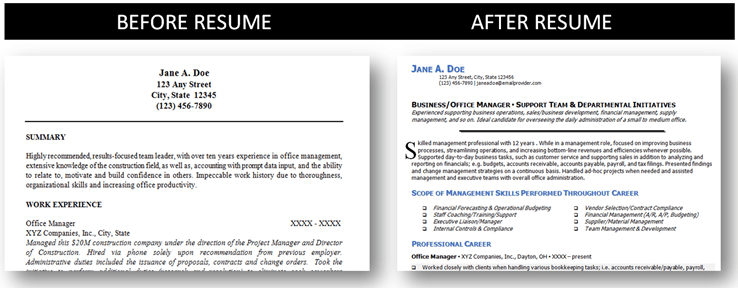
Before & After Resume Example
[Related Resource: Here are 100+ Inspirational Quotes For Jobseekers]
5. What To Do When You Have MORE JOBS Than You Know What To Do With
Job seekers are changing jobs more now than they did just 10 years ago.
Some experts speculate it’s about every 2-4 years on average.
An increase in the number of jobs held is making it difficult for managers to interpret a candidate’s full skill set because of the distraction between the number of jobs versus the quality of jobs.
A sizable list of jobs within any resume is perceived differently by those who hire. Keep in mind that the average resume is 1-2 pages.
Space is limited.
Hiring is expensive, and as companies continuously research, analyze, and implement strategies to improve costs, you bet reducing employee turnover and retaining great employees is a prime focus.
With this said, readers of your best resume might be wondering:
Why the continued change in roles?
Does he quit his job too often?
Was he fired once or twice?
Why didn’t former employers successfully keep him?”
Now more than ever, it’s important to make slow and calculated career moves.
Despite currently low unemployment rates, millions are unemployed, and record numbers of others are experiencing long-term joblessness.
My advice lately has been for job seekers to stay put and avoid the open job market when possible.
Here are some thoughts on doing just that …
1) Remain with employers for at least 2 years, preferably sticking it out even when the job doesn’t turn out exactly as you’d hoped.
Have you heard the saying, “You’ve made your bed now lay in it”?
Yes, not the smoothest medicine to swallow, I’m sorry, but it’s important to remain steady and not be hasty or erratic at the sign of trouble.
Instead of quitting or jumping ship and presuming the company isn’t about to go belly-up, maybe there’s a less invasive alternative.
Maybe you can change jobs but stay with the same employer?
Maybe you can ask for different/additional responsibilities?
Maybe you’re experiencing a rough patch that’ll pass with time and patience?
Remember, too, that an impending boss change can benefit your situation. If your current boss has been with the company for a few years, well, enough said. =]
2) Be proactive rather than reactive. Do the necessary research before accepting any role [proactive] so you don’t find yourself abruptly back on the market [reactive].
Know the whos, whats, wheres, and whens before accepting any new role.
Companies ask for 3rd, 4th, and 5th interviews [and more sometimes], so ask to meet with your expected boss to further discuss the job, identify your match, and so on.
Just a sampling of questions to ask and get answered:
What will be consuming my time?
Who will I be working with/reporting to?
What current problems exist within the department?
What does the company expect from me?
What measurement of success will you use to determine my value to the team, department, and bottom line?
Final “Food “for thought:
Would you apply hiring dollars to a candidate who changes jobs every 24-48 months or possesses a committed employment record?
When a large number of roles that cover a short period is perceived negatively, it can adversely affect one’s search and career.
BONUS: Will a LinkedIn Profile Replace Your Resume?
Some feel resumes’ shelf life is nearing an end. To our surprise, however, they haven’t become the outdated pieces of job-search collateral we thought they would.
When one considers new technologies being applied to job-search tasks, such as Facebook and LinkedIn, one must wonder exactly when the Internet meteor will arrive to finally “kill the resume.”
When you need an answer, who do you call?
You call on the experts, those on the hiring and recruitment side. So, I asked recruiters and hiring professionals two questions:
Will LinkedIn eventually replace the resume?
What’s the view from your side of the desk?
80%-90% who responded believe LinkedIn will not replace the resume anytime soon. I’m not surprised.
After all, LinkedIn hasn’t filled all the gaps and benefits of the resume — however, I feel they’re working on it. =]
LinkedIn profiles provide more candidate-specific detail (e.g., skills, endorsements) that resumes often do not.