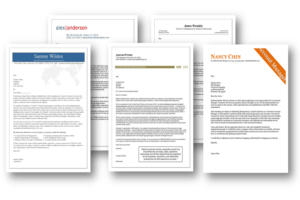
In this cover letter guide, we outline just about everything you need to know about cover letter writing.
Have you heard this: “Don’t send a cover letter. No one reads those.”
My response is generally this:
Really, not one person ANYWHERE in the whole wide world reads cover letters?
Yeah, I hear “no one reads those” too.
Here’s what I do when I think I’ve heard a line of crap.
I weigh those “blanket” comments against what I see, hear, and have experienced myself.
Are companies in Silicon Valley, those receiving upwards of 1,000 resumes (job applications) per day accepting cover letters too?
Probably not.
But for most of us who live in every day, non-glitter, mostly small to medium business parts of the world, cover letters are still wanted and needed.
So, the “don’t send a cover letter” doesn’t fly in most cases.
There are small/medium businesses (SMBs) for example that can’t afford costly talent management systems or recruiters and therefore conduct the hiring process with what some might call the “old-fashioned” way; and yes, they still ask for cover letters!
And when you don’t send a well-crafted, focused cover letter, this can actually cause problems when you’re not using a targeted resume.
An untargeted or substandard resume may the reason WHY a cover letter can be so important.
Smaller hiring companies that come to mind include banks, insurance agencies, community colleges, and so on. Heck, I recently had lunch with a recruiter friend who placed a candidate after receiving the individual’s resume and cover letter by postal mail.
Yup, snail mail!
There are folks who say the US postal service is dead too, but that doesn’t make it true for everyone, everywhere.
When You SHOULD NOT Send a Cover Letter
I suppose my point is this: because cover letters are less popular, or unwanted in some industries doesn’t mean they are obsolete or ineffective across all others.
Will cover letters become obsolete?
Yeah, they will — much like I believe the resume has an increasingly shorter shelf life too.
Research Yourself
Do a quick search using your favorite job board to see for yourself — thousands and thousands of job postings on Indeed, for example, are still asking for cover letters.
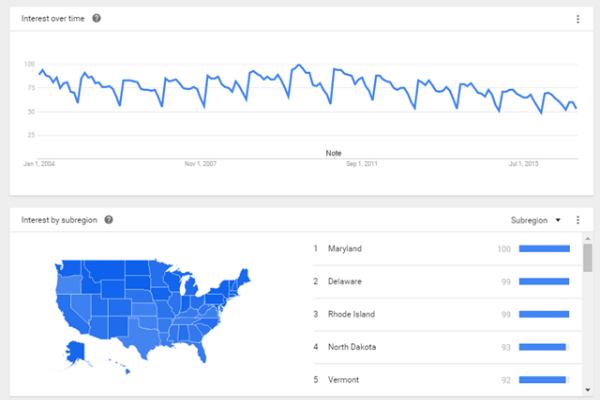
And, you might also consider that the keyword “cover letter” is still one of the most highly searched career keywords on Google (editorial note: it has shown a small downtick in the US in the past year or so).
Screenshot From Google Trends
The following is a look at Google Trends’ results for the key phrase “cover letter.”
From 2004 to the end of 2015, those searching for help with their cover letters via Google have remained virtually consistent.
And, this provides some evidence that cover letters are still “alive and strong,” at least for the moment. =]
What Your Cover Letter Content Should Focus On
When writing cover letters, it’s important that you focus ALL content on the hiring company.
It cannot be over-emphasized: as a job seeker, you are a salesperson attempting to market a product – in this case: you. The prospective employer is your customer, and your cover letters and resumes are your sales documents.
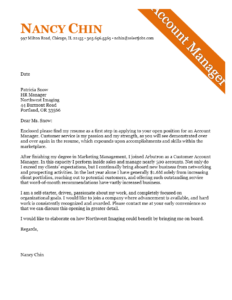
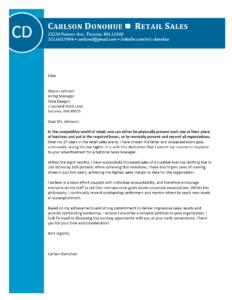
Example Cover Letter by Teena Rose @ ResumeToReferral.com
On the surface, there are many reasons why a person makes a purchase. It may be a desire for comfort, status, sex, security, pleasure, utility, or assistance.
However, when writing cover letters, all boils down to one concern:
“How will this product (you) fulfill the needs and wants of the hiring company?”
If you were a businessman operating a company from which you drew a salary that paid your bills and took care of your family, what would you want more than anything else?
The answer should be obvious.
Hiring companies want and very much need employees who can help the company make money, satisfy customers, cut costs, gain market share, and so on.
And this is where your cover letter and resume come into play. A cover letter’s “job” is to demonstrate how you can help the employer succeed, by showing what you’ve done in the past.
Some people make the mistake of including statements such as “it has been my lifelong dream to work as a ___________ for your marvelous company” or “I am seeking my dream job with __________, Inc.” when writing cover letters.
What NOT to Say When Reaching Out to Employers?
As hard as it might be to hear, an employer really doesn’t care about your dreams and desires – and nobody in that position likes being approached by someone they perceive as a boot-licker (okay, a great many people in jobs of power, in fact, do like lick-spittles and “yes-men” – but those employees still need to demonstrate they have the skills for the job. If you want the interview, play the game.) Remember, companies are looking for people who can contribute to bottom-line growth in some fashion.
The most important words you can use when writing cover letters are ‘you’ and ‘your,’ as in “I can help your company by building sales and increasing efficiency.” or “I can deliver the same superior results for you as I have for my previous employers.”
You want the cover letters you write to show that you have the skills to make the employer’s business better and more productive.
To that end, you’ll want to spend some time determining how your skills and experience will serve the company in increasing sales and profits or make operations more efficient and economical.
If the company or organization has a specific “mission statement,” you’ll want to become familiar with it – and address that in your cover letter and resume.
Always keep in mind that a company is in business to make a profit, and in fact, a publicly-traded company must by law do all it can to provide a return for its shareholders. Applicants whose cover letters convince the HR department that they are able to do the best job of facilitating a high rate of return for shareholders are the ones who will land the interview – and ultimately be hired for the job.
Main Purpose of The Cover Letters You Write
A cover letter’s main purpose is to serve as a “middleman” or connector between your resume and the job opening.
Think of it as an “introducer” of sorts.
Over the years, cover letters have taken on many different names, or what some classify as types of cover letters, including:
- Introduction letter
- Sales pitch letter
- Resume cover letter
- Cold contact letter
- Follow-up letter
- Referral letter
- Job-specific letter
Crazy, right?
Although the name changes, each type of cover letter is primarily designed to do one thing; pitch you to potential hiring companies.
Here are First Person Content Examples to Help You Improve Your Cover Letters
Look at these examples:
First Person: “In 2010, I earned the Top Employee of the Year award for my work on the Johnson project.”
Third Person: “In 2010, the company presented the Top Employee of the Year award to Sharon Nicholls for her work on the Johnson project.”
See the difference?
Not only did switching to the third person lead to a longer sentence, but it could also create confusion for the person in the HR office who is reading the letter. He/She might very well wonder who Sharon Nicholls is and why the writer is talking about her.
This type of confusion is more likely to happen than you might think; remember, the person reading your cover letter is also reading dozens – perhaps hundreds – of letters per day. Chances are very good that the reader doesn’t have your name memorized yet when they’re reading your letter.
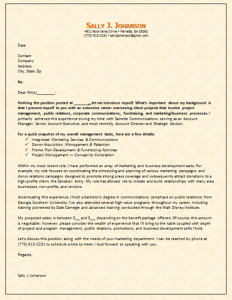
Example Cover Letter from Teena Rose @ ResumeToReferral.com
Another factor to consider is that business letters – and cover letters are morphed business letters – need to be clear and concise, without excess wordage or difficult grammar. You want people to be able to scan through your cover letter quickly and easily.
Remember, when it comes to cover letters and other business communications, less is more.
Finally, referring to one’s self in the third person can be seen as a sign of arrogance or weakness, whereas using a first-person cover letter makes you come across as strong and confident. Read these two sentences:
“I established a new department and grew it to $3M in sales in one year.”
vs.
“Mr. Smith was selected to launch a new department, and the sales reached $3M in one year.”
Which sentence makes you (remember, you are Mr. Smith) sound better?
If you were the HR Manager, which cover letter would be more likely to make you read Mr. Smith’s resume?
The reality is, when it comes to cover letters, the ‘I’s’ have it.
How To Write Letter Content To Be Different From Your Resume
Although tempting to ignore, the cover letters you write need to avoid reusing or regurgitating the exact same wordage included in your resume.
Yeah, yeah. I know what you’re thinking.
It sounds time-consuming, right?
Though, I’m here to set your mind at ease.
However, I’m here to tell you that writing a cover letter is simply to use the resume content as inspiration while reworking and re-scrambling the content so it’s not a carbon copy of one job-search document to the next.
Let’s say, you’re applying for a sales jobs …
You possess the necessary sales experience for the job, and your resume goes into great detail reflecting your sales accomplishments over the years.
The resume is designed to go into detail, so an approach to take with the cover letter might mean to write broader statements that “brush” your collection of sales achievements from a broader perspective.
For example, the following:
I’m a top sales performer — perfectly comfortable slipping into all sales responsibilities [note my first role in sales was focused on new sales while my current role is heavily involved in account management].
Over the years, my sales roles have collectively involved me in lead development, the closing of sales, customer relationship management, customer service, relationship building, cross-selling/up-selling, and project management.
In fact, my sales volumes generated from both new client relations and existing accounts routinely put me in the top 2% of my territories.
Other Mentionables to Include in Your Cover Letters
- Relocation choice or willingness to travel
- Salary requirement, if requested by the company
- Schedule requirement: part-time, full-time, telecommute, contract
- The alternate form of contact or availability for interview
- Answers to questions posed by the company
- Reflect work experience in replacement of education requirement
- Explain employment gaps or other career blemishes
- Highlight key points that match the hiring company’s requirements
Cover Letter Guide: 5 Quick Formatting Errors To Avoid
- SLOPPY COPY: MARGINS, FONT, PICA, AND CONTENT. The first impression given to any hiring agent is based on the overall appearance of your soft copy or printed cover letter because it’s the first item seen before proceeding onto the resume. If a cover letter arrives on that person’s desk or on their computer without consistent margins, font, pica, and without quality content, your candidacy has the potential of being “dead in the water” before the reader flips to your resume.
- LISTING UNRELATED SKILLS OR QUALIFICATIONS is probably the most common mistake candidates make with cover letters. Be wise and mention only those significant achievements that pertain to your current job or that of your current job focus. Listing irrelevant information in the cover letter can actually leave a negative impression, so revolve every sentence in your letter around the company’s needs and expectations of you.
- NO CONTACT NAME LISTED. By not listing a contact name for the hiring company, shows the lack of detail, not to mention, allowing the document to float around the employer’s office rather than sitting on the desk of the hiring agent. What if no contact information is available? Make a phone call to the company, or ask someone in your network for a contact name. Anytime you can add a personal salutation to your correspondence, you increase the chances of it being seen timely and by the right person.
- INCORRECT OR INCOMPLETE ADDRESS. Double-check everything — even if you pulled the address from the phone book, a classified ad, or the company website. Check two different locations to verify that the address you’re listing is 100% accurate and complete. Why go the extra mile? To answer this question, ask yourself how many times have the spelling of your name or mailing address been screwed up? Enough said.
- IMPROPER BUSINESS FORMAT. The lack of proper business format is another common mistake. Always use acceptable business format margins (for example, .75” to 1.0” left and right), and know when to indent and double space. To add an additional amount of flair to your letter, utilize the same font, margins, and header used within your resume. When reviewed as an entire package, whether online or when printed, each piece will look very professional and consistent. By following these simple do’s and don’ts, the art of writing an amazing cover letter should become easier.
Cover Letters Defined: Which Type of Cover Letter Should You Use?
Frankly, your eyes would cross if I told you every type of cover letter.
There’s really only one cover letter type, but over the years, professionals have taken to calling letters by more specific names to help define the purpose of the cover letter. For example, there are the cold-contact, job-specific, referral, and follow-up letters.
No doubt, most job searches will require different cover letters with varying written content that matches the goal of the letter. For example, here are a few select cover letter types you may need throughout your job-search campaign:
COLD-CONTACT COVER LETTER
A letter sent to a company, which may not have publicly advertised open jobs. Simply put, you’re sending an introduction to what a sales professional would call a “cold contact.” They don’t know you. They aren’t expecting correspondence from you.
A cold contact cover letter means you’re making an introduction with the hopes that your resume will arrive at an opportunistic time. With that, your letter may spark enough interest to result in a job interview. For obvious reasons, a cold-contact letter will generate the fewest leads.
Your correspondence will be faced with many obstacles, such as a strained hiring department, the potential that a job doesn’t exist for you, and possibly, your skillset doesn’t match their needs … even if they abruptly start hiring while your letter is in transit.
A cold-contact letter is also known as an introductory or broadcast letter.
JOB-SPECIFIC COVER LETTER
The most promising cover letter to send is the one sent to an open job. They need … you want … seems a win/win to me. =]
The company is seeking a new recruit and you’re perfect for the job; therefore, you write a cover letter that highlights the key mentionable of your career in relation to the company’s needs. A job-specific letter is also known as an ad-response letter.
REFERRAL COVER LETTER
One of the best producers of job interviews, a referral cover letter means that you’ve been referred to the company through a mutual acquaintance.
It’s best to mention your referrer within the intro paragraph of your letter, and preferably, place their name as prominently towards the top of the content as possible (the first sentence would be great!).
A referral letter is also known as a networking or sponsor letter. Since networking is still king when locating prime employment opportunities, a referral letter represents your best chances.
FOLLOW-UP COVER LETTER
A follow-up letter seems like a last-ditch effort on the part of a job seeker.
After all, companies don’t get their hiring butts moving as fast as we’d like.
This is why a follow-up cover letter can “get things moving.”
Sending a follow-up letter a couple of weeks after the submission of your original resume and cover letter, or a few days after an interview, can actually reflect your ambition and dedication to the employer — and in some cases, make you a more viable option to employers.
When sending a follow-up letter, list new and unique content whenever possible.
So, let’s talk about what your follow-up cover letter should include:
First, be unique in how you give thanks. Everyone likes to be recognized and thanked, even if the “tree fails to bear fruit.” But, be different about it.
For example, a job candidate could say something like this:
Thanks for meeting with me earlier this month, Mr. Johnson. Softball never attracted my interest before our meeting earlier this month. However, I found myself watching the U.S. Women’s Nationals this past weekend. I guess our brief chat about softball in my interview for your Network Admin job had an impact on my sport’s interests.
Not sure my wife is happy about that!
Thanks again for meeting with me and taking the time for the interview. Should you have any follow-up questions about my skill set, feel free to call me: (xxx) xxx-xxxx.
Regards,
Jon Smith
Giving thanks in this way refreshes the interviewer’s memory about you and a particular topic you discussed during your job interview.
Second, provide some broad details about your knowledge, skills, and abilities (KSAs) — and anything else about your that’s relevant (think transferable skills).
For example, here’s a great way to “marry” what the company is facing and how your KSAs can help the transition:
I remember you mentioning an upcoming staff merger, which if you remember, I led a staff integration when A2 Intl, LLC, merged with Bronson Welding last year. The integration process required new staff training, a deep assessment/realignment of job responsibilities, and in some instances, layoffs and reassignments.
Breakdown of Cover Letters
Below I break down the different paragraphs of the average cover letter. When you look logically at a cover letter, you realize that most cover letters really only have 3-5 paragraphs. And, most times, 2 of those paragraphs contain standard details.
So, you really only have to write 1-3 good, solid paragraphs … and you’re good to go!
Let’s start at the top:
First Paragraph – Introduction of Purpose
Here’s a more traditional of an example cover letter opening:
Dear Mr. Spacely:
I am writing regarding your opening for Supervisor of Matter/Anti-Matter Operations. I have 10 years of experience in Matter/Anti-Matter Operations, with a consistent record of reducing costs.
With today’s cover letters, it’s all about being fresh and unique.
What does this mean exactly?
Well, for starters, you can use a conversational tone when writing your letters.
I know.
This sounds a bit naughty!
So, I challenge you to start your sentences with “well” or “so.”
For example, “So, let me outline some of the core skills I have that are specific to your job opening.”
You’d make your English teacher cringe, but hey why not? 🙂
Here are two innovative ways (with examples) on how to start writing your cover letter:
Example#1 — “Reading Forbes magazine this morning, I noticed a large write-up about your company’s CEO in the June edition. He spoke extensively about how your company plans to expand into China between 2017 and 2020. Have worked extensively within the Southeast Asian market, I…”
Example#2 — “In January, nothing moves faster than a sales rep. With renewed sales goals and a fresh view on the new year, sales professionals like me all over the world hit the ground running. This is why I’m seeking new employment. My current employer is experiencing some financial challenges and looking to reduce the sales team 46% before the start of the next year. This is a challenge for me. I prefer to…”
Second Paragraph – Experience and Background
The second paragraph should guide readers and show them HOW you’re qualified. For example, the cover letter could then go on to say…
For the past three years, I have successfully overseen the assembly of Quantum Fusion Reactor Pumps for a major design company. This area of management allowed me to oversee staff hiring/training, department financials, assembly operations, and team safety/quality. I was also involved with a major assembly line realignment, which improved production by 13.8% and cut raw material costs by nearly 8%.
Third Paragraph – Credentials and Qualifications
I trained at the Sprocket Physics Institute between September of 2___ and June of 2___, and hold an Advanced Certification in Astro-Molecular Physics.
Should You Mention Volunteer Work?
When you have a work gap, volunteer work can serve as a fill-in — as long as it has some relevance to your work history/target job title.
This is when things can get tricky.
If you are ever wondering whether to include volunteer work in your resume (not just your cover letter), reach out to a professional resume writer for help. Deciding this should be made on a case by case basis.
How much detail should you include in your cover letter about your volunteer work?
The best approach is to focus on what you did in these volunteer roles that are important and transferable to your job target.
Think about:
- Financials
- Donor (Client) Services
- Administrative Support
- Community Outreach
- Marketing Communications
- Public Affairs
- Strategic Positioning
- Meeting Planning
- Scheduling
- Agency Relations
Guide to Stripping-Down Letter Content To Fit an Email
The brevity of emails contradicts what we typically see in a heavier-written cover letter. So, what do you do?
SOLUTION: When you forward a resume by email, utilize a chopped down version of your cover letter to flesh out 90% of your email.
Content from the first and second paragraphs are best suited and on-point for email.
Though DO eliminate formalities from your email cover letter. For example, avoid using intros such as, “please accept my resume in response to…” and “My skill set matches the XYX job on your website, therefore, I …”
Example of Cover Letter Content
Let’s say you are starting out, and this is the cover letter you are currently using are part of your job search:
Date
Contact
Company
Address
City, State Zip
Re:
Dear Mr(s).___________:
In today’s environment, it’s important to hit the ground running concerning your product lines, showing your competitors and business relationships exactly what a powerhouse your company continues to be. Bringing aboard a professional with an impressive record of generating millions from his existing product line will be pivotal to your team … a person who can jump right in and offer a fresh approach to selling and marketing your products nationally and globally.
My current role with The Rose Sims Company involves heavy involvement with global markets, along with consulting on and participating in the business development and marketing end of that role. We’re continuously in the midst of rolling out new products that require my input and direction every step of the way; initial market research and polling existing clients for a need to consulting on product mapping and market planning. With the depth of this knowledge, I’d be a perfect fit for the product management job at your company. You need a person who will bring new product “sustainment,” along with maintaining strong, and growing, sales from your core products.
Accentuating my product management background, note that I started my career going through the ranks serving within sales and as a senior application engineer. A person with a well-rounded background will certainly offer benefits beyond the obvious. Another key point is I possess a bachelor’s degree in Mechanical Engineering. Certainly, a nice combination of skills to ensure the product end of your business excels and prospers accordingly.
When considering my candidacy, keep the following of my accomplishments in mind:
- Assisted company regain #1 market position for South America
- Developed and launched new product lines; generated $1.8 million in additional revenue
- Grew sales by 98% in Chile and 54% in Peru
Given the opportunity, I would quickly comprehend your industry’s product lines and identify target markets to develop key accounts with unparalleled customer interest. I look forward to having an opportunity to discuss with you how I may fit in and complement your team.
Please feel free to call me at (xxx) xxx-xxxx.
Thank you for your time and consideration.
Sincerely,
Joe Jobseeker
Attachment
Example of Email Content — Based On The Above Cover Letter
Thank you for speaking with me earlier, Mr. Smith.
As I mentioned, within my current role, I’m continuously in the midst of rolling out new products within global markets. I provide input and direction every step of the way; initial market research and polling existing clients for a need to consulting on product mapping and market planning. With this knowledge, I’d be a perfect fit for your product manager opening.
Bringing aboard a professional with an impressive record of generating millions from his existing product line will be pivotal to your team … a person who can jump right in and offer a fresh approach to selling and marketing your products nationally and globally.
I’m available Friday afternoon for a second, more formal interview. You can reach me at (xxx) xxx-xxxx.
Regards,
Joe Jobseeker
Should Your Resume & Cover Letter Format Be The Same?
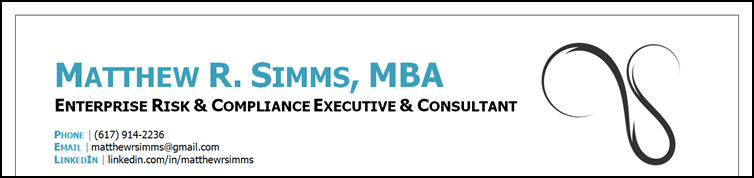
One of the most creative parts can be the cover letter header.
© Copyrighted. All Rights Reserved. Resume to Referral. Do Not Republish Without Written Permission.
This is where you can let your creative genius fly.
Cover letter and resume headers are very much like business letter stationary.
You can use a bit of color.
You can use a basic (professional) graphic.
You can mention things like MBA after your name if you have one.
You can also include your LinkedIn URL, and maybe, a quick snippet of your ideal job title.
See the above graphic for an example of these in action.